Imagine two people. Each receives a windfall of fifty thousand dollars. The first person buys a brand new car. The second person buys a small rental property. Five years later, the first person’s car is worth twenty thousand dollars. It has cost them thousands in insurance, maintenance, and fuel. The second person’s rental property is worth sixty thousand dollars. It has generated thousands in rental income. One person is poorer. The other is richer. The difference is understanding assets versus liabilities.
This distinction is the single most important concept in personal finance. It is the dividing line between those who build wealth and those who struggle. It is simple to understand but difficult to apply consistently because society constantly encourages us to buy liabilities while calling them assets.
Understanding assets vs liabilities is not an academic exercise. It is a practical framework for every financial decision you make. Should you buy the house or rent? Should you lease the car or buy used? Should you invest in education or buy luxury goods? The asset-liability framework provides the answer.
In this comprehensive guide, you will learn the clear definitions of assets and liabilities, why the distinction matters, how to identify whether something is truly an asset or a liability, the role of cash flow, common misconceptions, and how to apply this framework to build lasting wealth. By the end, you will see every purchase through a new lens.
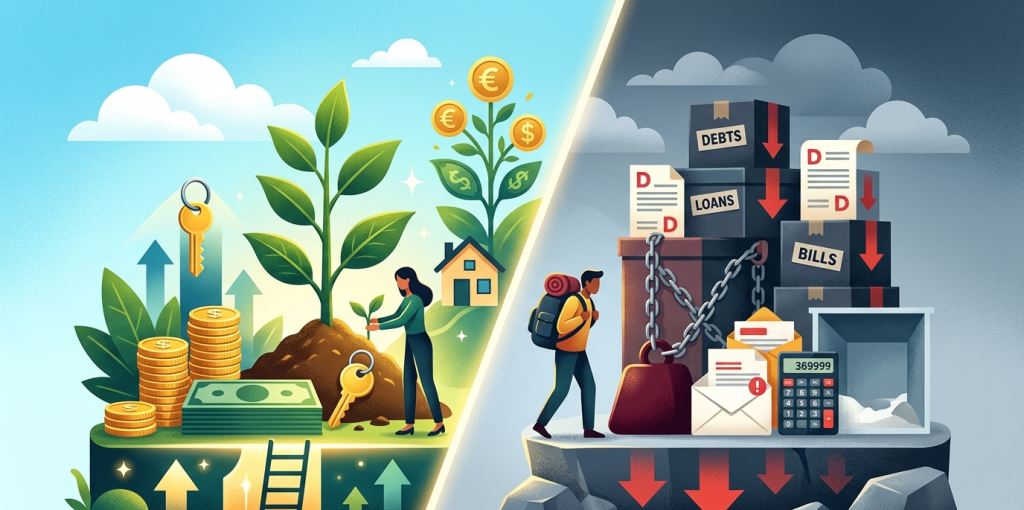
The Clear Definitions: What Is an Asset? What Is a Liability?
The definitions are simple, but they are often misunderstood. An asset is something that puts money in your pocket. A liability is something that takes money out of your pocket. That is it. Cash flow determines the classification.
An asset generates positive cash flow. It produces income. It appreciates in value. Or it does both. A rental property that generates monthly rent is an asset. A dividend-paying stock is an asset. A savings account that earns interest is an asset. A business that produces profit is an asset. A patent that earns royalties is an asset.
A liability generates negative cash flow. It requires ongoing expenses. It depreciates in value. Or it does both. A car loan requires monthly payments. A credit card balance accrues interest. A house that you live in requires mortgage payments, property taxes, insurance, and maintenance. A boat requires storage, insurance, fuel, and repairs. A timeshare requires annual fees.
Notice that a house you live in is a liability under this definition. It takes money out of your pocket every month. It does not generate income. This does not mean you should not own a home. It means you should understand what it is. A primary residence is a place to live, not an investment. It may appreciate over time, but it also costs money every month. The appreciation is not guaranteed. The costs are guaranteed.
The wealthy focus on acquiring assets. The middle class and poor focus on acquiring liabilities that they mistake for assets. A new car feels like an asset. You own it. It has value. But it takes money out of your pocket every month. It is a liability. A larger house feels like an asset. You own it. It may appreciate. But it takes more money out of your pocket than a smaller house. The extra square footage is a liability.
The table below shows common items classified as assets or liabilities based on their cash flow.
| Item | Classification | Why | Cash Flow Direction |
|---|---|---|---|
| Rental property | Asset | Generates monthly rental income | Money comes in |
| Dividend-paying stock | Asset | Pays regular dividends | Money comes in |
| Savings account | Asset | Earns interest | Money comes in |
| Bond | Asset | Pays regular interest | Money comes in |
| Business you own | Asset | Generates profit | Money comes in |
| Primary residence | Liability | Requires mortgage, taxes, insurance, maintenance | Money goes out |
| Car (financed) | Liability | Requires loan payments, insurance, fuel, maintenance | Money goes out |
| Car (owned outright) | Liability | Still requires insurance, fuel, maintenance, depreciates | Money goes out |
| Credit card balance | Liability | Accrues interest, requires payments | Money goes out |
| Personal loan | Liability | Requires regular payments | Money goes out |
| Boat | Liability | Requires storage, insurance, fuel, maintenance | Money goes out |
| Timeshare | Liability | Requires annual fees, special assessments | Money goes out |
| Collectibles | Asset (potentially) | May appreciate, no ongoing costs | Neutral (until sold) |
| Gold | Asset | No ongoing costs, stores value | Neutral (until sold) |
Why the Distinction Matters
The distinction between assets and liabilities matters because it determines your financial trajectory. Every dollar you spend on a liability is a dollar that is not spent on an asset. Every dollar you spend on an asset is a dollar that works for you.
When you spend money on a liability, the money is gone. The liability continues to take more money. A car requires insurance, fuel, maintenance, and repairs. A larger house requires higher property taxes, higher utility bills, and more maintenance. The initial purchase is just the beginning. The ongoing costs continue indefinitely.
When you spend money on an asset, the money is not gone. It is working. A rental property generates monthly income. A dividend stock pays quarterly dividends. The asset pays you back over time. Eventually, the asset may have paid for itself. After that, it generates pure profit.
The wealthy build portfolios of assets. They own rental properties. They own dividend stocks. They own businesses. They own bonds. These assets generate cash flow. The cash flow pays for their lifestyle. They do not need to work because their assets work for them.
The poor and middle class buy liabilities. They buy cars, boats, expensive homes, and luxury goods. These liabilities require cash flow to maintain. They must work to pay for their liabilities. When they stop working, the liabilities consume their savings. They never escape the cycle.
This is not about deprivation. It is about prioritization. You can buy liabilities. You should enjoy your money. But you should buy assets first. Build a base of assets that generate cash flow. Use that cash flow to buy liabilities. That is the path to wealth. Buying liabilities with earned income is the path to staying poor.
Robert Kiyosaki, author of “Rich Dad Poor Dad,” famously said: “Rich people acquire assets. The poor and middle class acquire liabilities that they think are assets.” This one sentence explains the wealth gap better than any economic theory. The difference is not income. It is understanding.
Cash Flow: The Deciding Factor
Cash flow is the deciding factor in whether something is an asset or a liability. Do not be confused by ownership. Do not be confused by value. Follow the cash.
A house you live in has value. You own it. But the cash flows are negative. You pay the mortgage, property taxes, insurance, and maintenance. Money goes out. It is a liability. A rental property also has value. You own it. But the cash flows are positive. Tenants pay rent. Money comes in. After paying the mortgage, taxes, insurance, and maintenance, there may be money left over. That positive cash flow makes it an asset.
The same physical object can be an asset or a liability depending on how you use it. A car used for a rideshare service generates income. It becomes an asset. The same car used only for personal transportation is a liability. A room in your house rented on a short-term platform generates income. It becomes an asset. The same room used only for storage is a liability.
This is the key insight. You can convert liabilities into assets by changing their use. You can turn your car into an asset by using it for deliveries or rideshare. You can turn your home into an asset by renting a room. You can turn your skills into an asset by starting a side business. The framework is not static. It is dynamic.
When evaluating a purchase, ask yourself: Will this put money in my pocket or take money out? Will this generate income or require expenses? Will this appreciate or depreciate? The answer tells you whether you are buying an asset or a liability.
Common Misconceptions
Many people believe things are assets when they are actually liabilities. These misconceptions are widespread and costly.
A primary residence is the most common misconception. People say, “My house is my biggest asset.” It is not. Your house is a liability. It takes money out of your pocket every month. It may appreciate over time, but appreciation is not guaranteed. The 2008 housing crash proved that home values can fall. Even if your house appreciates, you cannot access that appreciation without selling or borrowing. Meanwhile, the costs continue.
This does not mean homeownership is bad. Homeownership provides stability, privacy, and the ability to customize your living space. But it is not an investment. It is a place to live. Treat it as an expense, not an asset. When you calculate your net worth, include your home’s value. But understand that your home is not generating income. It is consuming it.
A car is another common misconception. People say, “I own my car outright. It is an asset.” Your car has value. You could sell it. But it is not generating income. It is costing you money. Insurance, fuel, maintenance, and depreciation are all expenses. The car is a liability. It may be a necessary liability. Most people need transportation. But call it what it is.
A college degree is sometimes called an asset. A degree can increase your earning potential. But the degree itself does not generate cash flow. Your job generates cash flow. The degree was an investment in your human capital. It may have been a good investment. But the piece of paper on your wall is not an asset under the cash flow definition.
Gold and collectibles are in a gray area. They have no ongoing costs if stored properly. They may appreciate. They do not generate income. They are not liabilities because they do not take money. They are not assets because they do not put money in. They are stores of value. They can be sold for cash, but they do not produce cash flow. They are better thought of as hedges or speculative investments rather than true assets.
How to Build Wealth with Assets
Building wealth is simple in concept. Acquire assets. Reduce liabilities. Let the cash flow from assets cover your expenses. Repeat.
Step one is to increase your earned income. This is where most people start. Get a job. Get a better job. Start a side business. Increase your skills. Earn more money. Earned income is the fuel for asset acquisition.
Step two is to spend less than you earn. This is the savings rate. Every dollar saved is a dollar that can be invested in assets. The higher your savings rate, the faster you acquire assets.
Step three is to invest the surplus in income-producing assets. Real estate that generates rent. Dividend stocks that pay quarterly. Bonds that pay interest. Businesses that produce profit. Peer-to-peer lending. Royalties from intellectual property. There are many types of assets. Choose those that match your risk tolerance and time horizon.
Step four is to reinvest the cash flow from assets. Do not spend the rental income. Do not spend the dividends. Reinvest them to buy more assets. This is the accelerator. The assets generate cash flow. The cash flow buys more assets. The new assets generate more cash flow. The cycle compounds.
Step five is to use asset cash flow to buy liabilities. Once your assets generate enough cash flow to cover your lifestyle, you have achieved financial independence. You can stop trading time for money. You can buy liabilities with the cash flow from assets. The car, the boat, the vacation. You are not spending earned income. You are spending asset income. The principal remains. The assets continue to generate.
This is the path that wealthy people follow. It is not secret. It is not complicated. It requires discipline and time. But it works.
Assets and Liabilities on Your Balance Sheet
A personal balance sheet lists your assets on one side and your liabilities on the other. Your net worth is assets minus liabilities.
Assets on a personal balance sheet include cash, investments, retirement accounts, real estate (at market value), vehicles (at current value), and personal property of value. Liabilities include mortgages, car loans, student loans, credit card balances, and any other debts.
The goal is to increase assets and decrease liabilities. But be careful. Not all assets are equal. A retirement account invested in index funds is a productive asset. It will grow over time. A car valued at thirty thousand dollars is also an asset on your balance sheet. But it is depreciating. It is not productive. It is a liability disguised as an asset.
When you calculate your net worth, include everything. But when you plan your financial future, focus on productive assets. A million dollars in depreciating cars and consumer goods is not the same as a million dollars in rental properties and dividend stocks. The first million will disappear as the cars age and the goods wear out. The second million will generate income and grow.
Track your net worth over time. It should increase each year. If it is not increasing, you are spending too much on liabilities and not enough on assets. Adjust your behavior.
The Bottom Line
Assets put money in your pocket. Liabilities take money out. This simple distinction is the most important concept in personal finance. It determines whether you build wealth or struggle.
The wealthy focus on acquiring assets. They own rental properties, dividend stocks, bonds, and businesses. These assets generate cash flow. The cash flow pays for their lifestyle. They do not need to work because their assets work for them.
The poor and middle class focus on acquiring liabilities that they mistake for assets. They buy cars, boats, expensive homes, and luxury goods. These liabilities require cash flow to maintain. They must work to pay for their liabilities. They never escape the cycle.
You can choose your path. Every financial decision is a choice between an asset and a liability. The car or the stock. The boat or the rental property. The vacation or the bond. Choose assets. Build wealth. Let your money work for you.
Your Next Step: Take out a piece of paper. Draw a line down the middle. Label one side “Assets” and the other side “Liabilities.” List everything you own that puts money in your pocket on the assets side. List everything you own that takes money out on the liabilities side. Be honest. Most people are surprised by how many liabilities they have. Then make a plan to acquire one new asset in the next ninety days. A dividend stock. A small rental property. A side business. Start small. Start now.
Disclaimer: This content is for educational purposes only and does not constitute financial advice. The classification of assets and liabilities depends on individual circumstances. Consult a financial advisor for advice specific to your situation.