Imagine building a house. You would not start with the roof. You would not start with the paint. You would start with the foundation. You would dig deep. You would pour concrete. You would ensure the ground is stable. Only then would you build walls and a roof and paint the walls.
Personal finance is the same. Many people want to jump straight to investing. They want to pick stocks. They want to get rich quickly. They skip the foundation. Their financial house collapses at the first storm.
The basic principles of personal finance are the foundation. They are not exciting. They do not promise quick riches. They are the boring, essential work that makes everything else possible. Master these principles, and you can build wealth. Ignore them, and no amount of investing skill will save you.
In this comprehensive guide, you will learn the fundamental principles that underpin every successful financial life. These principles work regardless of your income. They work regardless of the economy. They work regardless of interest rates. They are timeless. They are universal. They are the bedrock of financial freedom.
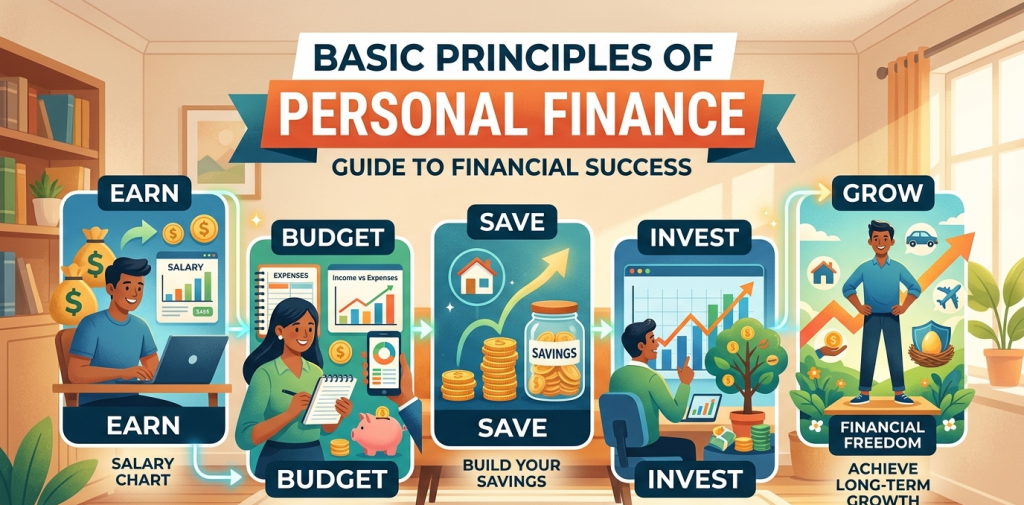
The Ten Basic Principles of Personal Finance
The table below summarizes the ten basic principles of personal finance. Each principle is explained in detail in the sections that follow.
| Principle | Core Idea | Key Action |
|---|---|---|
| 1. Spend less than you earn | The savings rate is the foundation | Track spending; create a budget |
| 2. Pay yourself first | Save before you spend | Automate transfers to savings |
| 3. Build an emergency fund | Prepare for the unexpected | Save 3-6 months of expenses |
| 4. Eliminate high-interest debt | Debt destroys wealth | Use avalanche or snowball method |
| 5. Understand the time value of money | A dollar today is worth more | Start saving early |
| 6. Harness compound interest | Interest earns interest | Reinvest earnings; be patient |
| 7. Diversify your investments | Don’t put all eggs in one basket | Own stocks, bonds, real estate |
| 8. Keep costs low | Fees consume returns | Use low-cost index funds |
| 9. Protect against catastrophe | Insurance is essential | Get health, disability, life insurance |
| 10. Plan for the long term | Wealth takes time | Stay disciplined; ignore noise |
Principle 1: Spend Less Than You Earn
This is the most basic principle. It is also the most important. If you spend less than you earn, you have a surplus. That surplus can be saved. That surplus can be invested. That surplus can grow. You are moving forward.
If you spend more than you earn, you have a deficit. That deficit must be borrowed. That debt accumulates interest. You are moving backward.
The size of your income does not determine your financial success. Many high-income earners are broke because they spend everything. Many moderate-income earners become wealthy because they save consistently. The ratio matters more than the absolute number.
To spend less than you earn, you must know what you earn and what you spend. Track your spending for one month. Categorize every expense. At the end of the month, add them up. Most people are shocked by how much they spend on small, discretionary items. Awareness is the first step to change.
Create a budget that aligns with your values. The fifty-thirty-twenty rule is a good starting point. Fifty percent of your after-tax income for needs. Thirty percent for wants. Twenty percent for savings and debt repayment. Adjust the percentages based on your situation. The key is to have a plan.
Principle 2: Pay Yourself First
Most people pay everyone else first. They pay the rent. They pay the utilities. They pay the phone bill. They pay the credit card. They pay for dinner. They pay for coffee. If anything is left at the end of the month, they save it. Nothing is left.
Paying yourself first reverses this order. Before you pay anyone else, you pay yourself. You transfer money to savings and investments as soon as you are paid. The rest of your money is what you have to spend.
When you pay yourself first, you remove the need for willpower. You do not have to decide each month whether to save. The decision is made once. The action happens automatically. Set up automatic transfers from your checking account to your savings account and investment accounts. The money moves before you can spend it.
How much should you pay yourself? A common target is twenty percent of your after-tax income. If you cannot reach twenty percent, start with ten percent. If you cannot reach ten percent, start with five percent. The amount does not matter. The habit matters. Increase your savings rate over time. Whenever you get a raise, save half of it. You never miss money you never see.
Principle 3: Build an Emergency Fund
Life is unpredictable. Jobs are lost. Cars break. Medical emergencies happen. These events are not if. They are when. An emergency fund turns a crisis into an inconvenience.
Without an emergency fund, an unexpected expense goes on a credit card. The credit card balance accrues interest. The interest grows. The debt spirals. The emergency becomes a long-term financial problem.
With an emergency fund, you pay the expense with cash. You replenish the fund over time. The emergency is over. Your financial life continues.
How much should you save? Three to six months of essential expenses. Essential expenses are rent or mortgage, utilities, food, insurance, and minimum debt payments. Not dining out. Not travel. Not entertainment.
Where should you keep your emergency fund? In a high-yield savings account. Not in the stock market. The stock market can fall just when you need the money. Not in a certificate of deposit. You may need the money before the CD matures. A high-yield savings account is safe, liquid, and earns interest.
Build your emergency fund before you do anything else. Before you invest. Before you pay extra on low-interest debt. Before you take a vacation. The emergency fund is the foundation. Build the foundation first.
Principle 4: Eliminate High-Interest Debt
Debt is not all bad. A mortgage on a home can be good debt. Student loans for a degree that increases your earning potential can be good debt. A loan to start a business can be good debt.
High-interest debt is bad debt. Credit card debt. Payday loans. Car loans with high rates. Personal loans with high rates. This debt destroys wealth. The interest compounds against you. Every dollar paid in interest is a dollar that is not invested.
The fastest way to eliminate high-interest debt is the avalanche method. List all debts from highest interest rate to lowest. Pay the minimum on all debts. Put every extra dollar toward the highest-rate debt. When that debt is paid off, move to the next highest.
The avalanche method saves the most money in interest. The snowball method pays the smallest balances first for psychological wins. Choose the method that works for you. The important thing is to start.
While paying off debt, maintain a small emergency fund of one thousand dollars. Without any emergency fund, unexpected expenses will create new debt. With one thousand dollars, you can handle small emergencies without borrowing.
Principle 5: Understand the Time Value of Money
A dollar today is worth more than a dollar in the future. This is the time value of money. A dollar today can be invested to become more than a dollar in the future. A dollar in the future cannot be invested today.
The time value of money explains why saving early is so powerful. A dollar saved at age twenty-five is worth approximately four dollars at age sixty-five, assuming seven percent returns. A dollar saved at age forty-five is worth approximately two dollars at age sixty-five. The early dollar is worth twice as much because it had twice as long to compound.
The time value of money also explains why debt is expensive. Every dollar paid in interest is a dollar that could have been invested. The true cost of a purchase made on credit is not just the purchase price. It is the foregone growth of that money if it had been invested instead.
Use the time value of money to your advantage. Start saving as early as possible. Pay off debt as quickly as possible. Let time work for you, not against you.
Principle 6: Harness Compound Interest
Compound interest is interest earned on interest. It is the engine of wealth building. It turns modest savings into substantial wealth over time.
If you invest one thousand dollars at ten percent simple interest, you earn one hundred dollars per year. After ten years, you have two thousand dollars. If you invest the same one thousand dollars at ten percent compound interest, you earn one hundred dollars in the first year. In the second year, you earn interest on one thousand one hundred dollars. After ten years, you have approximately two thousand five hundred ninety-three dollars. The difference grows over time.
The formula for compound interest is A = P(1 + r)^t. The exponent is time. This is why time is so powerful. The longer your money compounds, the more dramatic the growth.
To harness compound interest, start early. Be consistent. Reinvest all earnings. Avoid high fees. Stay invested. Let time do its work.
The Rule of 72 is a quick way to estimate the power of compound interest. Divide 72 by your annual return. The result is approximately the number of years to double your money. At eight percent, 72 divided by 8 equals 9 years to double. At six percent, 72 divided by 6 equals 12 years to double. At four percent, 72 divided by 4 equals 18 years to double.
Principle 7: Diversify Your Investments
Do not put all your eggs in one basket. This is the oldest investing advice. It is also the wisest. Diversification reduces risk without reducing expected returns. It is the only free lunch in finance.
When you own a single stock, your risk is high. That company could go bankrupt. When you own fifty stocks across different sectors, your risk is much lower. The failure of any single company will not destroy you. When you own stocks, bonds, real estate, and international investments, your risk is lower still.
The simplest way to diversify is to own index funds. A total US stock market index fund owns thousands of companies. A total international stock index fund owns thousands more. A total bond market index fund owns thousands of bonds. With three funds, you are diversified across thousands of securities, dozens of sectors, and dozens of countries.
Do not confuse diversification with complexity. Owning fifty different funds is not better than owning five. A simple portfolio of three to seven low-cost index funds is sufficient for almost any investor.
Principle 8: Keep Costs Low
Every dollar you pay in fees is a dollar that is not compounding for you. Over decades, the difference between a low-cost portfolio and a high-cost portfolio is staggering.
An S&P 500 index fund might charge 0.03 percent per year. An actively managed fund might charge 1.00 percent per year. Over thirty years, that 0.97 percent difference consumes approximately twenty-five percent of your potential returns. On a five hundred thousand dollar portfolio, that is over one hundred twenty-five thousand dollars.
Keep costs low in three ways. First, use low-cost index funds and ETFs. Avoid actively managed funds with high expense ratios. Second, avoid sales loads. Never pay a commission to buy a fund. Third, minimize trading. Every trade incurs costs and potential taxes.
The financial industry will not help you keep costs low. They profit from high fees. You must help yourself. Read the prospectus. Compare expense ratios. Choose the lowest-cost option for each investment.
Principle 9: Protect Against Catastrophe
No amount of saving and investing matters if a single catastrophe wipes you out. Insurance is the protection against catastrophe. It is not exciting. It does not build wealth. But it prevents wealth from being destroyed.
Health insurance is the most important. A single medical emergency can cost hundreds of thousands of dollars. Without insurance, that debt can follow you for life. With insurance, you pay a deductible and coinsurance. The insurance covers the rest.
Disability insurance protects your income. If you cannot work due to illness or injury, disability insurance replaces a portion of your income. Without it, you could lose everything. Most employers offer group disability insurance. Consider supplemental coverage.
Life insurance protects your dependents. If you have children or a spouse who depends on your income, term life insurance is essential. It is inexpensive. A healthy thirty-year-old can get five hundred thousand dollars of coverage for twenty to thirty dollars per month.
Homeowners or renters insurance protects your home and belongings. Auto insurance protects you on the road. Umbrella insurance provides additional liability coverage beyond your other policies.
Review your insurance coverage annually. Make sure you have adequate coverage at reasonable prices. Do not skip insurance to save a few dollars. The risk is too great.
Principle 10: Plan for the Long Term
Wealth is built slowly. There are no shortcuts. Anyone who promises quick riches is selling something. The stock market has returned approximately ten percent annually over the long term. That is doubling every seven years. It is not doubling every week.
The long-term perspective protects you from emotional mistakes. When the market crashes, the long-term investor stays invested. They know the market has always recovered. It always will. When the market soars, the long-term investor does not chase. They know what goes up can come down.
Write a financial plan. Include your goals, your time horizon, your risk tolerance, and your asset allocation. Review the plan annually. Update it as your life changes. Follow the plan during good times and bad.
Ignore the noise. Turn off the financial television. Unsubscribe from market commentary emails. Do not check your portfolio daily. The news is designed to make you anxious. Anxiety leads to bad decisions. Stay disciplined. Stay the course.
The Bottom Line
The basic principles of personal finance are not complicated. They are not secrets. They are the foundation that every successful financial life is built upon. Spend less than you earn. Pay yourself first. Build an emergency fund. Eliminate high-interest debt. Understand the time value of money. Harness compound interest. Diversify your investments. Keep costs low. Protect against catastrophe. Plan for the long term.
These principles work regardless of your income. They work regardless of the economy. They work regardless of interest rates. They are timeless. They are universal. Master them, and you can build wealth. Ignore them, and no amount of investing skill will save you.
Start today. Not tomorrow. Not next month. Today. Track your spending. Create a budget. Open a high-yield savings account. Set up automatic transfers. Pay off your credit cards. Open a Roth IRA. Invest in low-cost index funds. Review your insurance. Write a plan. Take one step. Then another. Then another. The path to financial freedom is long, but every step moves you forward.
Your Next Step: Choose one principle from this guide. Just one. Implement it this week. If you do not have an emergency fund, open a high-yield savings account and set up an automatic transfer. If you have credit card debt, make a plan to pay it off. If you have not started investing, open a Roth IRA. Do not try to do everything at once. One step at a time. Start now.
Disclaimer: This content is for educational purposes only and does not constitute financial advice. All investing involves risk, including the potential loss of principal. Past performance does not guarantee future results. Consult a licensed financial advisor for advice specific to your situation.