Imagine you deposit one thousand dollars into your checking account. You think that money is sitting in a vault somewhere, waiting for you to withdraw it. It is not. Your bank has already lent that money to a small business owner buying new equipment, to a family getting a mortgage, and to a student paying for college. Your money is not sitting still. It is moving. It is working. It is the lifeblood of the economy.
The financial system is often described as mysterious, complex, and impenetrable. It is none of these things. It is a system of institutions, markets, and instruments that move money from people who have it to people who need it. Savers supply money. Borrowers demand money. Intermediaries like banks, credit unions, and investment funds connect them.
Understanding how the financial system works is not just for economists and bankers. It affects every aspect of your life. The interest rate on your mortgage. The return on your retirement savings. The availability of credit to start a business. The stability of your job. All of these depend on the health and functioning of the financial system.
In this comprehensive guide, you will learn how the financial system works from the ground up. You will learn about the central bank, commercial banks, financial markets, intermediaries, and the plumbing that moves trillions of dollars every day. By the end, you will see the financial system not as a mystery but as a machine, and you will understand your place within it.
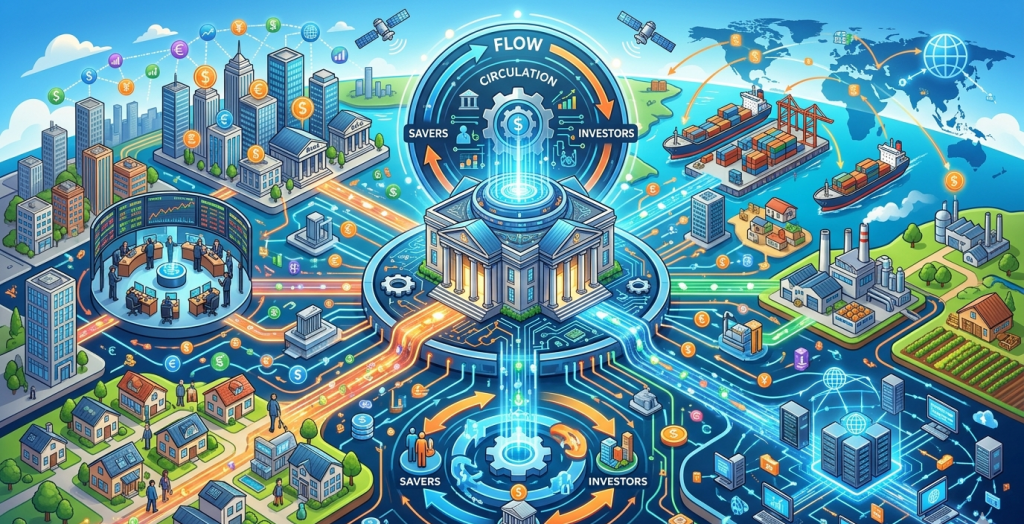
The Core Function: Moving Money from Savers to Borrowers
At its most basic level, the financial system has one job: moving money from people who have it to people who need it. Savers have excess money they do not need to spend immediately. Borrowers need money to spend before they have earned it.
Savers include households saving for retirement, corporations with excess cash, and governments running surpluses. Borrowers include homebuyers taking mortgages, students taking loans, businesses investing in new equipment, and governments running deficits.
The financial system connects savers and borrowers in three ways. Direct financing occurs when a saver buys a bond or stock directly from a borrower. A corporation issues a bond. An investor buys it. The money moves directly from the investor to the corporation.
Indirect financing occurs through financial intermediaries like banks. A saver deposits money in a bank. The bank pools that money with deposits from thousands of other savers. The bank lends the pooled money to borrowers. The saver never meets the borrower. The bank stands between them.
Market-based financing occurs through financial markets like the stock market and bond market. Companies issue stocks and bonds. Investors buy and sell them on exchanges. The prices of these securities are determined by supply and demand.
The table below summarizes the three methods of moving money from savers to borrowers.
| Method | How It Works | Examples | Risk Level | Intermediary |
|---|---|---|---|---|
| Direct Financing | Saver buys security directly from borrower | Corporate bond, municipal bond | Higher (saver bears credit risk) | None or broker |
| Indirect Financing | Bank or credit union collects deposits and makes loans | Savings account funding a mortgage | Lower (bank bears credit risk) | Bank, credit union |
| Market-Based Financing | Securities traded on exchanges | Stock market, bond market, ETF market | Varies by security | Exchange, broker, clearinghouse |
Central Banks: The Conductors of the Orchestra
The central bank is the most important institution in the financial system. In the United States, the central bank is the Federal Reserve, often called the Fed. Other countries have their own central banks: the European Central Bank, the Bank of England, the Bank of Japan, the People’s Bank of China.
The central bank has several critical functions. First, it conducts monetary policy. It sets the short-term interest rate that influences all other interest rates in the economy. When the Fed wants to stimulate the economy, it lowers rates. When it wants to cool inflation, it raises rates.
Second, the central bank acts as the lender of last resort. When banks are in trouble and no one else will lend to them, the central bank steps in. This prevents bank runs and financial panics. During the 2008 financial crisis, the Fed provided emergency loans to banks that would otherwise have failed.
Third, the central bank regulates and supervises banks. It ensures that banks have enough capital to survive losses. It conducts stress tests to see how banks would fare in a severe recession. It enforces consumer protection laws.
Fourth, the central bank manages the payment system. It operates the systems that clear and settle trillions of dollars in transactions every day. When you send a wire transfer, the Fed’s systems are involved behind the scenes.
The Fed does not set all interest rates directly. It sets the federal funds rate, which is the rate banks charge each other for overnight loans. This rate influences but does not determine mortgage rates, credit card rates, and corporate bond rates. The bond market, expectations about future Fed actions, and global economic conditions all play a role.
In 2026, the Fed is in a challenging position. After raising rates aggressively to fight inflation, rates are now at their highest level in decades. The Fed must balance the risk of keeping rates too high (causing a recession) against the risk of cutting too soon (allowing inflation to reignite). The central bank’s decisions affect every borrower and every saver in the country.
Commercial Banks: The Main Street Intermediaries
Commercial banks are the financial institutions you interact with most directly. They take deposits, make loans, and provide payment services. Examples include Chase, Bank of America, Wells Fargo, and thousands of smaller regional and community banks.
Banks make money through the spread. They pay interest on deposits, typically low rates. They charge interest on loans, typically higher rates. The difference is the bank’s profit. A bank might pay one percent on savings accounts and charge six percent on mortgages. The five percent spread covers the bank’s operating costs, loan losses, and profit.
Banks also make money from fees. Monthly maintenance fees, overdraft fees, ATM fees, and credit card fees all add to bank revenue. This is why choosing a no-fee bank account is important. The fees you pay are the bank’s profit.
Banks are required to hold capital. Capital is the bank’s own money, as opposed to depositors’ money. Capital acts as a cushion against losses. If a bank makes bad loans and borrowers default, the bank can absorb losses with its capital. If losses exceed capital, the bank fails. Regulators require banks to hold a minimum amount of capital based on the riskiness of their loans.
Banks are also required to hold reserves. Reserves are cash held at the Federal Reserve or in the bank’s own vault. Reserves ensure that banks can meet withdrawal demands. If too many depositors try to withdraw at once, a bank could run out of reserves even if its loans are good. This is a bank run. The FDIC (Federal Deposit Insurance Corporation) insures deposits up to two hundred fifty thousand dollars, which prevents most bank runs.
In 2026, the banking system is generally healthy. Capital levels are high. Loan quality is good. But regional banks remain under pressure from higher interest rates, which have reduced the value of their bond portfolios. The failure of Silicon Valley Bank in 2023 was a reminder that even seemingly healthy banks can fail quickly when depositors panic.
Credit Unions: The Not-for-Profit Alternative
Credit unions are similar to banks but with important differences. Credit unions are not-for-profit cooperatives owned by their members. Anyone who deposits money is a member and an owner. Banks are for-profit corporations owned by shareholders.
Because credit unions do not need to earn profits for shareholders, they can offer better terms to members. Higher interest rates on savings. Lower interest rates on loans. Fewer and lower fees. Credit unions also tend to have better customer service ratings than large banks.
The trade-off is that credit unions have fewer branches and fewer ATMs than large banks. They may also have less sophisticated technology. However, most credit unions belong to shared branching networks, allowing members to use thousands of branches nationwide. Many also reimburse out-of-network ATM fees.
To join a credit union, you must meet eligibility requirements. Most credit unions serve specific geographic areas, employers, or associations. However, eligibility has expanded significantly. Many credit unions now allow anyone who lives, works, or worships in a certain area to join. Others have opened membership to anyone who joins a partner organization, often for a small donation.
In 2026, credit unions hold approximately ten percent of all deposits in the United States. Their market share has grown as consumers have become frustrated with bank fees. For most people, a credit union is an excellent alternative to a traditional bank, especially for savings accounts and auto loans.
Financial Markets: Where Securities Are Traded
Financial markets are where securities like stocks, bonds, and commodities are bought and sold. The most famous financial markets are the New York Stock Exchange (NYSE) and the Nasdaq. But there are many others: the Chicago Mercantile Exchange for futures, the Chicago Board of Trade for commodities, and countless bond markets.
The primary market is where new securities are issued. When a company goes public through an initial public offering (IPO), it sells shares to investors for the first time. The company receives the money from the sale. This is primary market activity.
The secondary market is where existing securities are traded among investors. When you buy Apple stock on the Nasdaq, you are buying from another investor, not from Apple. Apple does not receive any money from that transaction. The secondary market provides liquidity, allowing investors to buy and sell easily. This liquidity makes the primary market possible. Investors would not buy new shares if they could not later sell them.
Market makers are firms that stand ready to buy and sell securities at quoted prices. They provide liquidity by always being willing to trade. Market makers earn profits from the bid-ask spread: the difference between the price at which they buy and the price at which they sell.
Brokers are firms that execute trades on behalf of customers. Online brokers like Fidelity, Schwab, and Robinhood allow you to buy and sell securities with a few clicks. The broker routes your order to an exchange, a market maker, or an internal crossing network. Best execution rules require brokers to seek the best available price for your order.
In 2026, financial markets are faster and more automated than ever. Trades execute in microseconds. Algorithms dominate trading volume. The human trader at a desk is largely a relic of the past. Despite the speed and complexity, the fundamental function remains the same: connecting buyers and sellers.
The Payment System: Moving Money Invisibly
The payment system is the plumbing of the financial system. It is invisible when it works and catastrophic when it fails. Every time you swipe a debit card, send a wire transfer, or deposit a check, you are using the payment system.
The Automated Clearing House (ACH) network processes most electronic payments in the United States. Direct deposits, bill payments, and online transfers between bank accounts typically use ACH. ACH payments are batched and processed periodically throughout the day. They are inexpensive but not instantaneous.
Wire transfers are processed in real time. When you send a wire, the money moves almost immediately from your bank to the recipient’s bank. Wires are more expensive than ACH, typically twenty to thirty dollars, but they are faster and final.
The card networks—Visa, Mastercard, American Express, and Discover—process debit and credit card transactions. When you swipe your card, the network communicates with your bank to verify funds, places a hold on the amount, and later settles the transaction. Card networks charge merchants a fee, typically one to three percent of the transaction amount.
Real-time payment systems are the newest development. The FedNow service, launched in 2023, allows instant payments twenty-four hours a day, seven days a week. Funds are available immediately. Real-time payments are transforming how people and businesses send money.
In 2026, the payment system continues to evolve. Cryptocurrencies like Bitcoin offer an alternative payment system outside traditional banking. Stablecoins like USDC are used for instant settlement between crypto exchanges. Central bank digital currencies (CBDCs) are being tested in several countries. The future of payments will likely be faster, cheaper, and more diverse, but the core function of moving money from payer to payee remains unchanged.
Financial Intermediaries Beyond Banks
Banks are not the only financial intermediaries. Several other types of institutions move money from savers to borrowers.
Money market funds pool deposits from investors and invest in short-term, low-risk securities like Treasury bills. They offer higher interest rates than bank savings accounts but are not FDIC insured. In 2026, with interest rates high, money market funds hold trillions of dollars.
Mutual funds and ETFs pool money from many investors and invest in stocks, bonds, or other assets. They provide diversification and professional management. Index funds are a type of mutual fund or ETF that tracks a market index.
Pension funds manage retirement savings for workers. They invest contributions and pay benefits to retirees. Pension funds are among the largest investors in financial markets, holding trillions of dollars in stocks and bonds.
Insurance companies collect premiums from policyholders and invest those premiums until claims are paid. They are major buyers of corporate bonds and real estate. The long-term nature of insurance liabilities allows them to invest in less liquid assets.
Hedge funds and private equity funds pool money from wealthy individuals and institutions. They use complex strategies, including leverage and derivatives, to seek high returns. These funds are lightly regulated and risky. They are not suitable for most individual investors.
Each type of intermediary has a different risk profile, different regulatory regime, and different role in the financial system. Together, they form a web of connections that moves money from savers to borrowers efficiently.
Financial Regulation: Keeping the System Safe
The financial system is heavily regulated. Regulation serves several purposes: protecting consumers, ensuring stability, preventing fraud, and promoting competition.
The Federal Reserve regulates bank holding companies and state-chartered banks that are members of the Federal Reserve System. The Office of the Comptroller of the Currency (OCC) regulates nationally chartered banks. The FDIC regulates state-chartered banks that are not Fed members. The Consumer Financial Protection Bureau (CFPB) enforces consumer protection laws.
The Securities and Exchange Commission (SEC) regulates stock markets, mutual funds, ETFs, and publicly traded companies. The SEC requires companies to disclose financial information. It prosecutes insider trading and other securities fraud.
The Commodity Futures Trading Commission (CFTC) regulates futures, options, and derivatives markets. It also regulates digital commodities like Bitcoin under the SEC/CFTC joint interpretation issued in early 2026.
Regulation is not perfect. The 2008 financial crisis occurred despite extensive regulation. Regulators sometimes miss emerging risks. Banks sometimes find ways around rules. But the system is much safer today than it was before the crisis. Capital requirements are higher. Stress tests are regular. Derivatives are cleared through central counterparties. The financial system is more resilient.
In 2026, new regulatory challenges have emerged. Digital assets, artificial intelligence in trading, and the concentration of market power in a few large firms all pose risks. Regulators are adapting, but the race between innovation and regulation never ends.
The Bottom Line
The financial system is a machine for moving money from savers to borrowers. Central banks set the rules and provide stability. Commercial banks take deposits and make loans. Credit unions offer not-for-profit alternatives. Financial markets allow securities to be traded. The payment system moves money invisibly. Intermediaries provide specialized services. Regulation keeps the system safe.
Understanding how the financial system works empowers you to use it more effectively. You can choose where to deposit your money. You can decide how to borrow. You can invest in markets. You can avoid fees. You can protect yourself from fraud.
The financial system is not perfect. It has crises. It has scandals. It has inefficiencies. But it is essential. Without it, savers would have nowhere to put their money safely. Borrowers would have no way to finance homes, education, or businesses. The economy would grind to a halt.
You are part of this system. Every time you deposit a paycheck, pay a bill, or check your retirement balance, you are participating. Understanding how it works helps you participate more effectively. It helps you make better decisions. It helps you build wealth.
Your Next Step: Identify every financial institution you use: your bank, your credit card issuer, your investment provider, your insurance company. For each one, understand its role in the financial system. Is it a bank? A credit union? A brokerage? An insurance company? Then understand how you are protected. Is your deposit FDIC insured? Is your investment SIPC protected? Knowledge is the first step to using the system effectively.
Disclaimer: This content is for educational purposes only and does not constitute financial advice. The financial system is complex and subject to change. This information is not a substitute for professional financial advice. Consult a financial advisor for advice specific to your situation.