The year is 2026. A young couple sits at a kitchen table, surrounded by papers. They have found their dream home. The price is within their budget. The neighborhood is perfect. The schools are excellent. There is only one thing standing between them and the front door: the mortgage.
They have heard horror stories. Adjustable rates that exploded. Closing costs that doubled. Prepayment penalties that trapped borrowers. They are confused by the jargon. Fixed-rate? ARM? Points? APR? Escrow? Private mortgage insurance? The words swim before their eyes.
This couple is not alone. Millions of homebuyers sign mortgage documents every year without fully understanding what they are signing. They trust the lender. They trust the real estate agent. They trust that everything will work out. Most of the time, it does. But when it does not, the consequences are devastating. Foreclosure. Bankruptcy. Years of financial recovery.
Understanding mortgage basics is not optional for homebuyers. It is essential. A mortgage is likely the largest debt you will ever take on. The difference between a good mortgage and a bad mortgage can be tens of thousands of dollars over the life of the loan. The difference between understanding your mortgage and being confused by it can be the difference between keeping your home and losing it.
In this comprehensive guide, you will learn everything you need to know about mortgages. You will learn the basic definition of a mortgage, the major types of mortgages, the key concepts like APR, points, and PMI, how to qualify for a mortgage, and how to choose the right mortgage for your situation. By the end, you will be able to walk into any lender’s office with confidence.
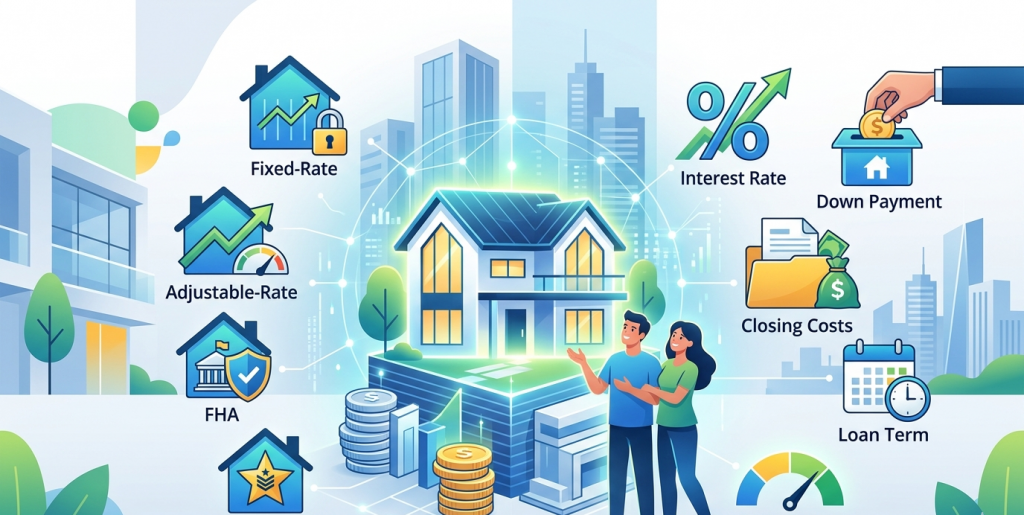
What Is a Mortgage? The Basic Definition
A mortgage is a loan used to purchase real estate. The borrower agrees to pay back the loan, plus interest, over a set period of time, typically fifteen or thirty years. The unique feature of a mortgage is that the property itself serves as collateral. If the borrower fails to make payments, the lender can take possession of the property through a legal process called foreclosure.
The word “mortgage” comes from Old French. “Mort” means death. “Gage” means pledge. A mortgage was literally a “death pledge” – the pledge died when the loan was repaid or when the property was taken. Fortunately, modern mortgages are less morbid, but the basic structure remains.
Every mortgage has several components. The principal is the amount of money you borrow. The interest is the fee the lender charges for borrowing the money. The term is the length of time you have to repay the loan. The monthly payment is the amount you pay each month, which typically includes principal, interest, property taxes, and homeowner’s insurance.
When you make a monthly payment, the money is applied first to interest, then to principal. In the early years of a mortgage, most of your payment goes to interest. In the later years, most goes to principal. This process is called amortization.
Before you even think about mortgages, make sure your banking foundation is solid. If you are still paying monthly maintenance fees or overdraft charges, you are throwing away money that could be going toward your down payment. For a complete guide to eliminating bank fees, check out How to Choose a No-Fee Bank Account – the strategies there have saved readers hundreds of dollars per year, money that can be redirected to your home purchase.
The Major Types of Mortgages
Not all mortgages are the same. The type of mortgage you choose affects your interest rate, your monthly payment, and your long-term costs. Understanding the differences is essential.
The table below summarizes the major types of mortgages available in 2026.
| Mortgage Type | Interest Rate | Term | Best For | Key Risk |
|---|---|---|---|---|
| Fixed-Rate Mortgage | Fixed for entire term | 15, 20, or 30 years | Buyers who plan to stay long-term; want predictable payments | Higher initial rate than ARM |
| Adjustable-Rate Mortgage (ARM) | Fixed for initial period, then adjusts | 5/1, 7/1, 10/1 common | Buyers who plan to sell or refinance within initial fixed period | Rates can rise significantly after adjustment |
| FHA Loan | Fixed or adjustable | 15 or 30 years | Buyers with lower credit scores or smaller down payments | Mortgage insurance premium for life of loan |
| VA Loan | Fixed or adjustable | 15 or 30 years | Veterans, active military, and surviving spouses | Funding fee (can be rolled into loan) |
| USDA Loan | Fixed | 30 years | Buyers in eligible rural areas | Geographic restrictions |
| Jumbo Loan | Fixed or adjustable | 15 or 30 years | Buyers borrowing above conforming loan limits | Higher rates; stricter qualification |
Now let us explore each type in detail.
Fixed-Rate Mortgage
A fixed-rate mortgage has an interest rate that never changes. If you borrow three hundred thousand dollars at six percent for thirty years, your principal and interest payment will be approximately one thousand seven hundred ninety-nine dollars for all three hundred sixty months. Property taxes and insurance may change, but the loan portion of your payment is locked.
The thirty-year fixed-rate mortgage is the most common mortgage in the United States. The longer term means lower monthly payments but more total interest. The fifteen-year fixed-rate mortgage has higher monthly payments but much less total interest. On a three hundred thousand dollar loan at six percent, the thirty-year mortgage costs approximately three hundred forty-seven thousand dollars in total interest. The fifteen-year mortgage costs approximately one hundred fifty-five thousand dollars in total interest – a savings of nearly two hundred thousand dollars.
Fixed-rate mortgages are best for buyers who plan to stay in their home for many years. If you expect to live in the home for ten or more years, the certainty of a fixed rate is valuable. You never have to worry about rising rates increasing your payment.
Adjustable-Rate Mortgage (ARM)
An adjustable-rate mortgage has an interest rate that is fixed for an initial period, then adjusts periodically based on a market index. A 5/1 ARM has a fixed rate for five years, then adjusts once per year. A 7/1 ARM is fixed for seven years. A 10/1 ARM is fixed for ten years.
ARMs typically have lower initial interest rates than fixed-rate mortgages. The lender offers a lower rate because you are taking the risk that rates will rise after the fixed period. If you plan to sell the home or refinance before the adjustment period, an ARM can save you money.
But ARMs carry significant risk. If interest rates rise sharply, your monthly payment can increase dramatically. A three hundred thousand dollar ARM that adjusts from four percent to seven percent would see its monthly payment rise from approximately one thousand four hundred thirty-two dollars to approximately one thousand nine hundred ninety-six dollars – an increase of over five hundred dollars per month.
ARMs are best for buyers who know they will sell or refinance within the fixed period. If you are buying a starter home and expect to move in five years, a 5/1 ARM might be a good choice. If you plan to stay for twenty years, a fixed-rate mortgage is safer.
Government-Backed Loans
FHA loans are insured by the Federal Housing Administration. They allow down payments as low as 3.5 percent and accept credit scores as low as 580. The trade-off is mortgage insurance. FHA loans require an upfront mortgage insurance premium of 1.75 percent of the loan amount, plus annual premiums that can last for the life of the loan.
VA loans are guaranteed by the Department of Veterans Affairs. They are available to veterans, active military members, and surviving spouses. VA loans require no down payment and have no mortgage insurance. They have a funding fee, which can be rolled into the loan. VA loans often have the most favorable terms of any mortgage type.
USDA loans are guaranteed by the United States Department of Agriculture. They are available for homes in eligible rural areas. USDA loans require no down payment and have reduced mortgage insurance. Income limits apply. Geographic restrictions apply.
Conforming vs. Jumbo Loans
Conforming loans meet the guidelines set by Fannie Mae and Freddie Mac, the government-sponsored enterprises that buy mortgages from lenders. In 2026, the conforming loan limit for a single-family home in most areas is seven hundred sixty-six thousand five hundred fifty dollars. In high-cost areas, the limit is higher.
Jumbo loans exceed the conforming limit. They have higher interest rates and stricter qualification requirements. Lenders typically require larger down payments, higher credit scores, and lower debt-to-income ratios for jumbo loans.
Key Mortgage Concepts You Must Understand
Beyond the basic types, several key concepts affect the cost and terms of your mortgage.
Annual Percentage Rate (APR)
The APR is the true cost of borrowing, expressed as a yearly percentage. It includes not only the interest rate but also fees like origination fees, discount points, and mortgage insurance. The APR is almost always higher than the interest rate.
When comparing loan offers, always compare APRs, not just interest rates. A loan with a lower interest rate but higher fees might have a higher APR than a loan with a slightly higher interest rate but lower fees. The APR tells you the true cost.
Points (Discount Points)
Points are prepaid interest. One point equals one percent of the loan amount. If you borrow three hundred thousand dollars, one point costs three thousand dollars. Paying points lowers your interest rate. The reduction varies by lender and market conditions, but one point typically lowers the rate by 0.25 percent.
Points make sense if you plan to stay in the home for a long time. The upfront cost is offset by lower monthly payments over many years. If you plan to sell or refinance soon, paying points is probably not worth it.
Private Mortgage Insurance (PMI)
Private mortgage insurance protects the lender if you default on the loan. Lenders require PMI when your down payment is less than twenty percent of the home’s purchase price. PMI typically costs 0.5 to 1.5 percent of the loan amount per year, paid as part of your monthly payment.
PMI can be removed once your loan-to-value ratio reaches eighty percent. You may need to request removal in writing. Once the ratio reaches seventy-eight percent, the lender must automatically remove PMI.
Loan-to-Value Ratio (LTV)
The loan-to-value ratio is the loan amount divided by the home’s appraised value. If you buy a three hundred thousand dollar home with a two hundred forty thousand dollar loan, your LTV is eighty percent. A lower LTV means less risk for the lender, which typically means a lower interest rate and no PMI.
Debt-to-Income Ratio (DTI)
Your debt-to-income ratio is the percentage of your monthly gross income that goes toward debt payments. Lenders use this ratio to determine whether you can afford a mortgage. Most lenders prefer a DTI below forty-three percent. Some will go up to fifty percent with strong compensating factors.
To calculate your DTI, add up all your monthly debt payments: mortgage or rent, car loans, student loans, credit card minimum payments, and any other loans. Divide that total by your monthly gross income. Multiply by one hundred to get a percentage.
Escrow
An escrow account is an account held by the lender to pay your property taxes and homeowner’s insurance. Each month, you pay an additional amount beyond your principal and interest. The lender holds this money in escrow and pays your taxes and insurance when they are due.
Escrow accounts protect the lender. If you fail to pay your property taxes, the government could place a lien on the property, potentially ahead of the lender’s claim. Escrow ensures that taxes and insurance are paid on time. Some lenders allow you to waive escrow if you have a large down payment and a good payment history, but you may pay a fee for this privilege.
How to Qualify for a Mortgage
Mortgage qualification has become more straightforward in 2026, but the requirements remain rigorous. Lenders evaluate five main factors.
Credit Score
Your credit score is the most important factor in mortgage qualification. Higher scores qualify for lower interest rates. The minimum credit score for a conventional loan is typically 620. FHA loans accept scores as low as 580. VA loans have no official minimum, but most lenders want at least 620.
Before applying for a mortgage, check your credit report for errors. Dispute any mistakes. Pay down credit card balances. Do not apply for new credit in the months before your mortgage application.
Income and Employment
Lenders want to see stable, reliable income. They typically require two years of employment history in the same field. If you are self-employed, you will need two years of tax returns showing consistent or increasing income.
Lenders verify your income through pay stubs, W-2 forms, tax returns, and bank statements. They may contact your employer directly.
Assets and Down Payment
Lenders need to see that you have the funds for your down payment and closing costs. They will request bank statements for the past two to three months. Large, unexplained deposits may need to be explained and documented.
The minimum down payment varies by loan type. Conventional loans can go as low as three percent for first-time homebuyers. FHA loans require 3.5 percent. VA and USDA loans require zero down payment. Jumbo loans typically require ten to twenty percent.
Debt-to-Income Ratio
Most lenders want your front-end DTI (housing expenses only) below 28 percent and your back-end DTI (all debt) below 43 percent. Some government-backed loans allow higher ratios with compensating factors like a large down payment or excellent credit.
Property Appraisal
The lender will order an appraisal of the property. The appraiser determines the fair market value. The loan amount is based on the lower of the purchase price or the appraised value. If the appraisal comes in low, you may need to increase your down payment or renegotiate the purchase price.
Fixed vs. Adjustable: Making the Right Choice
The choice between a fixed-rate mortgage and an adjustable-rate mortgage is one of the most important decisions you will make. The right choice depends on your plans and your risk tolerance.
Choose a fixed-rate mortgage if you plan to stay in the home for more than seven to ten years. The certainty of a fixed payment is valuable. You will never be surprised by a rate increase. You can budget with confidence. The slightly higher initial rate is the price of that certainty.
Choose an adjustable-rate mortgage if you are certain you will sell or refinance before the adjustment period. If you are buying a starter home and expect to move in five years, a 5/1 ARM might save you money. The lower initial rate reduces your payments during the time you own the home. You will be gone before any rate adjustment.
But be honest with yourself. Life does not always go as planned. You might intend to sell in five years, but the housing market might crash. You might lose your job. You might have a child and need more space. Many homeowners who took ARMs intending to sell found themselves stuck when the market turned. If there is any chance you might stay beyond the fixed period, a fixed-rate mortgage is safer.
The Bottom Line
A mortgage is the largest debt most people will ever take on. Understanding the basics is not optional. It is essential for protecting your financial future.
You now know the major types of mortgages: fixed-rate, adjustable-rate, FHA, VA, USDA, and jumbo. You know the key concepts: APR, points, PMI, LTV, DTI, and escrow. You know how to qualify for a mortgage and how to choose between fixed and adjustable rates.
Before you apply for a mortgage, get your financial house in order. Pay down debt. Improve your credit score. Save for a down payment. And eliminate unnecessary bank fees – every dollar saved is a dollar closer to homeownership.
A mortgage is a tool. Used wisely, it helps you build wealth through homeownership. Used unwisely, it can trap you in debt for decades. Choose wisely. Understand your loan. Read every document before you sign. Your future self will thank you.
Your Next Step: Check your credit score today. If it is below 680, work on improving it before applying for a mortgage. Pay down credit card balances. Do not apply for new credit. Save for a larger down payment. Then shop with at least three different lenders. Compare their APRs, fees, and terms. Choose the best offer. Read every document before you sign.
Disclaimer: This content is for educational purposes only and does not constitute financial advice. Mortgage terms, interest rates, and fees vary by lender and change over time. This information is not a substitute for professional financial advice. Consult a mortgage professional or financial advisor before making home financing decisions.