If you’re researching neobanks, you’re probably asking a deeper question: Are they actually better than traditional banks — or just better at marketing?
As someone who has spent years analyzing banking models, digital finance structures, and regulatory frameworks, I can tell you this: the difference between neobanks and traditional banks is not just about having an app instead of a branch. It’s structural. It’s operational. And in many cases, it’s strategic.
In this guide, I’ll break down:
- What neobanks really are
- How they differ from traditional banks
- Regulatory and safety considerations
- Advantages and disadvantages
- Who should (and shouldn’t) use them
Let’s go beyond the surface.
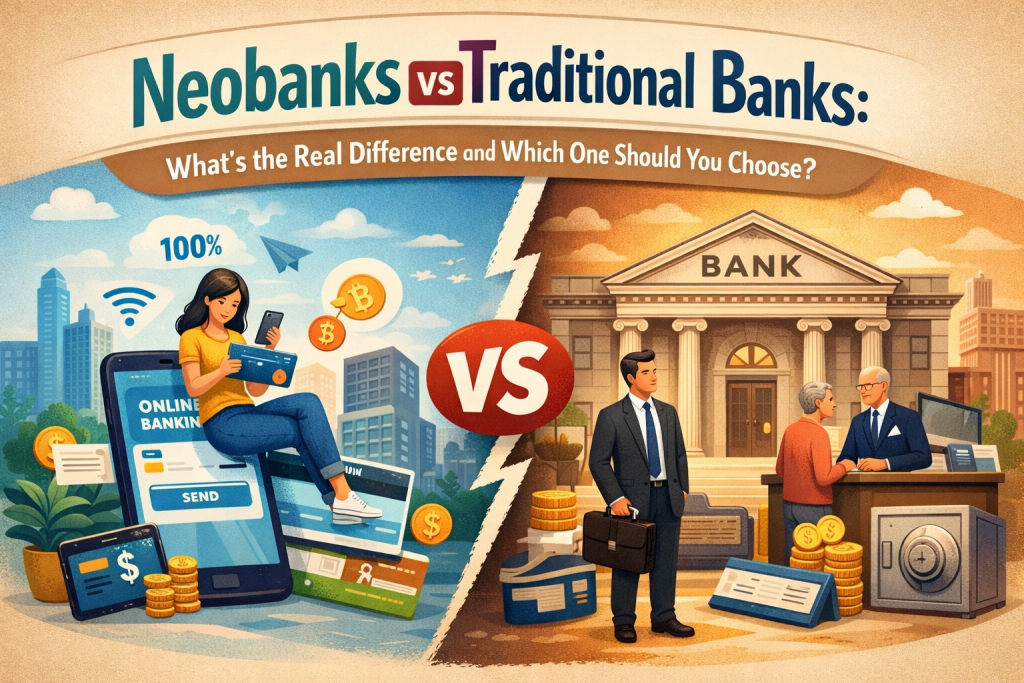
What Is a Neobank and How Does It Actually Work?
A neobank is a digital-first financial institution that operates without physical branches. Everything — onboarding, customer service, transactions, identity verification — happens online, usually through a mobile app.
Well-known examples include:
- Revolut
- N26
- Chime
- Monzo
But here’s where most people get confused.
Not All Neobanks Are Real Banks
From a regulatory standpoint, there are two main models:
- Licensed neobanks — They hold a full banking license.
- Partner-based neobanks — They operate under another bank’s license.
For example, in Europe, many digital banks are regulated under the supervision of the European Central Bank or national authorities. In the U.S., deposits may be insured through partner banks under the Federal Deposit Insurance Corporation (FDIC).
In my experience analyzing digital banking models, this distinction is critical. One of the biggest mistakes I see people make is assuming all neobanks operate under identical regulatory frameworks. They don’t.
How Neobanks Make Money
Neobanks typically generate revenue through:
- Interchange fees (card transactions)
- Premium subscriptions
- FX margins
- Lending products
- Marketplace commissions
Because they don’t maintain expensive branch networks, their cost structure is significantly leaner. That allows them to offer lower fees — sometimes zero monthly fees — compared to traditional banks.
But lower costs don’t always mean better service in every context.
What Is a Traditional Bank?
A traditional bank is a regulated financial institution with:
- Physical branches
- In-person advisors
- Broad product offerings
- Long-established infrastructure
Examples include:
- JPMorgan Chase
- Bank of America
- HSBC
- BBVA
Traditional banks operate under strict national and international regulatory systems. In Europe, supervision may involve the Banco de España or other national regulators alongside the ECB. In the U.S., oversight includes the Federal Reserve and FDIC structures.
The Classic Banking Model
Traditional banks make money through:
- Interest spreads (loans vs deposits)
- Mortgage lending
- Business financing
- Investment services
- Asset management
- Advisory services
Unlike most neobanks, traditional banks usually provide:
- Complex credit facilities
- Corporate banking
- Wealth management
- Large-scale lending products
In my analysis of financial institutions over the years, this is where the biggest structural gap appears: neobanks focus on retail simplicity, while traditional banks manage systemic complexity.
Neobanks vs Traditional Banks: Core Differences
Let’s break this down clearly.
1. Infrastructure and Cost Structure
Neobanks operate without physical branches. This reduces overhead dramatically.
Traditional banks maintain:
- Real estate
- Branch staff
- Operational legacy systems
- Compliance departments with large physical footprints
Lower operational costs give neobanks flexibility to eliminate fees or offer better FX rates. However, branch-based banks may provide more robust advisory services.
2. Technology Stack
Neobanks are built on modern cloud-based systems. Their architecture is agile and API-driven.
Traditional banks often rely on legacy core systems built decades ago. Upgrading these systems is complex and expensive.
From a fintech perspective, this technological gap is one of the strongest competitive advantages neobanks have.
3. Customer Experience
Neobanks prioritize:
- Instant account opening
- Real-time notifications
- Budgeting tools
- Intuitive interfaces
Traditional banks are improving digital offerings, but often still require physical processes for complex operations.
One thing I’ve observed repeatedly: users who prioritize convenience and speed almost always prefer neobanks.
4. Product Depth
Traditional banks win in product diversity:
- Mortgages
- Business loans
- Structured investments
- Complex credit lines
Neobanks often start with:
- Current accounts
- Debit cards
- Basic lending
- International payments
Some are expanding, but they’re not yet full-spectrum financial institutions.
5. Regulation and Deposit Protection
This is where many people worry.
Deposit protection depends on jurisdiction:
- In the U.S., FDIC insurance typically covers up to $250,000.
- In the EU, deposit guarantee schemes generally cover up to €100,000.
If a neobank has a banking license, deposits are protected under the same schemes as traditional banks. If it operates under a partner bank, coverage usually applies via that partner.
As someone deeply involved in financial regulation analysis, I always advise checking the exact license model before opening an account.
Advantages of Neobanks
- Lower or zero monthly fees
- Superior mobile experience
- Faster onboarding
- International-friendly services
- Transparent fee structures
Neobanks excel at everyday banking efficiency.
Disadvantages of Neobanks
- Limited physical presence
- Fewer complex financial products
- Customer service may be app-based only
- Some rely on third-party banking partners
In more complex financial situations — like mortgage structuring or business financing — traditional banks still dominate.
Are Neobanks Safe?
This is the most searched question around neobanks.
The short answer: yes — if properly licensed and regulated.
But safety depends on:
- Regulatory jurisdiction
- Deposit guarantee scheme
- Operational stability
- Risk management model
In my experience, the real risk isn’t fraud or collapse — it’s misunderstanding what type of institution you’re dealing with.
A fully licensed digital bank is not inherently riskier than a traditional bank. However, a fintech operating under limited licensing may not offer identical protections.
Always verify:
- Who holds the banking license
- Which authority supervises it
- What deposit guarantee applies
Who Should Choose a Neobank?
Neobanks are ideal for:
- Digital-first users
- Freelancers
- Travelers
- Young professionals
- People who want low-cost everyday banking
If your financial needs are simple — salary deposits, payments, budgeting — a neobank may be more efficient.
Who Should Stick With a Traditional Bank?
Traditional banks may be better if you:
- Need mortgage advice
- Run a medium or large business
- Require complex financing
- Value in-person advisory relationships
- Manage significant investment portfolios
For high-net-worth individuals or corporate structures, traditional banks still offer deeper institutional capabilities.
The Strategic Reality: It’s Not Either/Or
One of the most important conclusions I’ve reached after years studying financial ecosystems is this:
Most financially savvy individuals use both.
- A neobank for daily transactions and FX efficiency.
- A traditional bank for credit, mortgages, and structured products.
This hybrid strategy is increasingly common.
Final Verdict: Are Neobanks Replacing Traditional Banks?
Not entirely.
Neobanks are redefining retail banking expectations. They’ve forced traditional banks to accelerate digital transformation.
But traditional banks still dominate in:
- Large-scale lending
- Corporate banking
- Institutional finance
- Regulatory infrastructure
The future of banking is likely hybrid, not replacement.
Conclusion
The difference between neobanks and traditional banks goes far beyond having branches or not. It’s about structure, regulation, cost models, and strategic focus.
Neobanks offer speed, transparency, and low-cost everyday banking.
Traditional banks offer depth, scale, and institutional strength.
The smartest decision isn’t emotional — it’s strategic.
Choose based on your financial complexity, not marketing slogans.
Frequently Asked Questions
Are neobanks real banks?
Some are fully licensed banks. Others operate under partner licenses. Always verify regulatory status.
Are neobanks safer than traditional banks?
If licensed and regulated under official deposit schemes, safety levels are comparable.
Do neobanks offer mortgages?
Some do, but most still focus on retail banking and payments.
Why are neobanks cheaper?
They operate without physical branches, reducing operational costs.