Imagine two investors. One is twenty-five years old, just starting her career, saving for retirement that is forty years away. The other is sixty-five years old, retired, living off her savings. They both receive the same piece of news: the stock market has fallen twenty percent.
The young investor checks her portfolio, shrugs, and buys more shares with her next paycheck. She has decades for the market to recover. The fall is an opportunity, not a threat.
The retired investor checks her portfolio and feels a chill. She needs that money to pay her bills for the next thirty years. A twenty percent loss means she may have to cut her spending. She cannot afford to wait a decade for a recovery. The fall is a threat, not an opportunity.
The same event. The same percentage loss. Completely different implications. The difference is time horizon and risk profile.
Understanding investment time horizon and risk profile explained is not an academic exercise. It is the difference between investing in a way that supports your life goals and investing in a way that sabotages them. Your time horizon determines how much risk you can afford to take. Your risk profile determines how much risk you are willing to take. The intersection of these two factors is your optimal investment strategy.
In this comprehensive guide, you will learn what time horizon means, why it matters more than almost any other factor, how to determine your own time horizon, what risk profile means, the different types of risk tolerance, how to assess your true risk tolerance, and how to match your portfolio to both your time horizon and your risk profile.
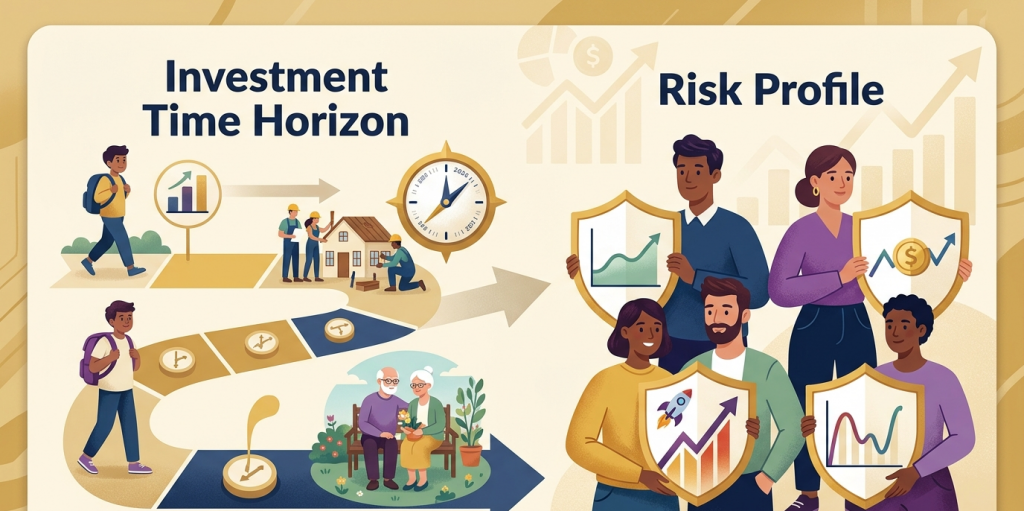
What Is Investment Time Horizon?
Investment time horizon is the length of time you expect to hold an investment before you need to access the money. It is measured from today until the date you plan to sell the investment and use the proceeds.
Time horizons fall into three broad categories: short-term, medium-term, and long-term. Each category has different implications for the types of investments that are appropriate.
Short-term horizons are less than three years. Money needed in the next three years should not be in the stock market. The market can fall significantly in any given year. It can take several years to recover. If you need the money in two years and the market falls thirty percent in year one, you will be forced to sell at the bottom. Short-term money belongs in cash, high-yield savings accounts, certificates of deposit, or short-term Treasury bills. These investments will not grow much, but they will not lose value when you need them.
Medium-term horizons are three to ten years. Money needed in this window can tolerate some risk, but not as much as long-term money. A conservative portfolio of thirty to fifty percent stocks and fifty to seventy percent bonds is appropriate. The bonds provide stability. The stocks provide some growth. The combination reduces the risk of a large loss just before you need the money.
Long-term horizons are more than ten years. Money that you will not need for a decade or more can tolerate significant risk. The stock market has never had a negative return over any twenty-year period in history. Over ten-year periods, the probability of a positive return is approximately ninety-four percent. Long-term money can be invested aggressively, with seventy to ninety percent in stocks.
The table below shows the relationship between time horizon, appropriate investments, and expected outcomes.
| Time Horizon | Category | Appropriate Investments | Stock Allocation | Expected Volatility | Risk of Loss at Withdrawal |
|---|---|---|---|---|---|
| 0-3 years | Short-term | Cash, CDs, T-bills, high-yield savings | 0-10% | Very low | Very low |
| 3-5 years | Short-medium | Short-term bond funds, conservative balanced funds | 10-30% | Low | Low |
| 5-10 years | Medium-term | Balanced funds, moderate allocation funds | 30-60% | Moderate | Moderate |
| 10-15 years | Medium-long | Growth funds, stock-heavy balanced funds | 60-80% | High | Low (over 10+ years) |
| 15+ years | Long-term | Stock funds, aggressive growth funds | 80-100% | Very high | Very low (over 15+ years) |
The key insight from this table is that the risk of losing money when you need to withdraw decreases as your time horizon increases. For short-term money, the risk is high because you have no time to recover from a loss. For long-term money, the risk is low because you have decades to ride out any downturn.
Why Time Horizon Is the Most Important Factor
Time horizon is not just one factor among many. It is the most important factor in determining your investment strategy. It trumps risk tolerance, market conditions, and even tax considerations.
The reason is mathematical. The stock market is volatile in the short term but remarkably consistent in the long term. The longer you hold stocks, the higher the probability that you will achieve a positive return. Over one year, the probability of a positive return in the S&P 500 is approximately seventy-three percent. Over ten years, it is ninety-four percent. Over twenty years, it is one hundred percent.
This means that time horizon transforms risk. For a long-term investor, the volatility of stocks is not risk. It is noise. The only risk that matters is the risk that the market will be lower in twenty years than it is today. That risk is essentially zero. For a short-term investor, volatility is the primary risk. A temporary decline becomes a permanent loss if you are forced to sell.
Time horizon also determines your capacity to recover from mistakes. A young investor who makes a bad investment has decades to make up for it. A retired investor who makes a bad investment may never recover. The young investor can afford to take more risk. The retired investor cannot.
This is why target-date retirement funds automatically shift from stocks to bonds as the target date approaches. When you are twenty-five years from retirement, the fund holds mostly stocks. When you are five years from retirement, the fund holds mostly bonds. The time horizon shrinks, so the risk exposure shrinks.
The most common mistake new investors make is ignoring their time horizon. They invest money they need in two years in aggressive stock funds because they want high returns. Then the market falls, and they are forced to sell at a loss. They blame the market. They should blame their time horizon mismatch.
What Is Risk Profile?
Risk profile is a measure of your willingness and ability to tolerate investment losses. It has two components: risk capacity and risk tolerance.
Risk capacity is your objective ability to withstand losses. It is determined by your time horizon, your income, your savings, your debt, and your other financial obligations. A young investor with a stable job, low debt, and a long time horizon has high risk capacity. A retired investor with no income, high medical expenses, and a short time horizon has low risk capacity.
Risk tolerance is your subjective willingness to withstand losses. It is determined by your personality, your emotions, your past experiences, and your psychological makeup. Some people can watch their portfolio fall forty percent and feel nothing. They may even buy more. Other people cannot sleep when their portfolio falls ten percent. They check their brokerage app obsessively. They feel physical pain when they see red numbers.
Your risk profile is the intersection of your risk capacity and your risk tolerance. If your risk capacity is high but your risk tolerance is low, you should invest conservatively. You will not be able to stick with an aggressive portfolio through a bear market. If your risk capacity is low but your risk tolerance is high, you should still invest conservatively. You cannot afford to lose money even if you are willing to take the risk.
The most common mistake is overestimating risk tolerance. Investors read about the historical returns of stocks. They see that stocks have returned ten percent annually. They decide to put all their money in stocks. They have never experienced a bear market. Then the market falls twenty percent. They panic. They sell. They lock in their losses. They miss the recovery. They would have been better off with a more conservative portfolio that they could hold through the decline.
Be honest with yourself. If you have never experienced a bear market as an investor, you do not know your true risk tolerance. Start conservatively. Add risk gradually as you gain experience. It is easier to increase risk than to recover from a panic sale.
The Five Risk Profiles
Investors generally fall into one of five risk profiles. Each profile has a different recommended asset allocation.
The conservative investor prioritizes capital preservation over growth. They are willing to accept low returns in exchange for high safety. They may be near retirement, living off their portfolio, or simply have a low tolerance for loss. A conservative portfolio typically holds ten to thirty percent stocks and seventy to ninety percent bonds and cash. The expected return is modest, perhaps three to five percent annually. The maximum drawdown is small, typically less than ten percent.
The moderate-conservative investor wants some growth but is not willing to accept large losses. They may be five to ten years from retirement or have a moderate tolerance for risk. A moderate-conservative portfolio typically holds thirty to fifty percent stocks and fifty to seventy percent bonds. The expected return is moderate, perhaps four to six percent annually. The maximum drawdown is moderate, typically ten to twenty percent.
The moderate investor balances growth and safety equally. They are willing to accept some volatility in exchange for higher long-term returns. They may be ten to twenty years from retirement or have an average tolerance for risk. A moderate portfolio typically holds fifty to seventy percent stocks and thirty to fifty percent bonds. The expected return is good, perhaps six to eight percent annually. The maximum drawdown is significant, typically twenty to thirty percent.
The moderate-aggressive investor prioritizes growth but wants some stability. They are willing to accept significant volatility in exchange for higher returns. They may be twenty to thirty years from retirement or have a high tolerance for risk. A moderate-aggressive portfolio typically holds seventy to ninety percent stocks and ten to thirty percent bonds. The expected return is high, perhaps seven to nine percent annually. The maximum drawdown is severe, typically thirty to forty percent.
The aggressive investor prioritizes growth above all else. They are willing to accept extreme volatility in exchange for the highest possible long-term returns. They may be more than thirty years from retirement or have an extremely high tolerance for risk. An aggressive portfolio typically holds ninety to one hundred percent stocks. The expected return is very high, perhaps eight to ten percent annually. The maximum drawdown is extreme, typically forty to fifty percent or more.
Most investors should be in the moderate or moderate-aggressive range. Conservative and aggressive profiles are for specific situations, not general use.
How to Assess Your True Risk Tolerance
Assessing your risk tolerance is difficult because it is easy to overestimate. The following questions will help you get a more accurate picture.
First, how did you react to the 2022 bear market? If you were invested at that time, your reaction is the single best predictor of your true risk tolerance. Did you buy more? Did you hold steady? Did you sell some? Did you panic sell everything? Be honest. Your actions reveal your tolerance better than any questionnaire.
Second, how often do you check your portfolio? Daily checkers tend to have lower risk tolerance than monthly checkers. Frequent checking is a sign of anxiety. If you check daily, you probably need a more conservative portfolio.
Third, how would you feel about a thirty percent loss? This is not a hypothetical. Thirty percent losses happen. The S&P 500 fell fifty-one percent in 2008. It fell thirty-four percent in 2020. It fell twenty-five percent in 2022. If the thought of a thirty percent loss makes you nauseous, you should hold fewer stocks.
Fourth, what is your time horizon? If you need the money in less than five years, your risk tolerance is irrelevant. You cannot afford to take risk regardless of how willing you are. Time horizon trumps risk tolerance.
Fifth, do you have a stable income and a fully funded emergency fund? Investors with stable jobs and six months of expenses in cash can afford to take more risk. Investors with unstable jobs or no emergency fund should take less risk.
If you are unsure about your risk tolerance, start with a conservative portfolio. You can always add risk later. You cannot undo a panic sale.
Matching Time Horizon and Risk Profile to Your Portfolio
Once you understand your time horizon and your risk profile, you can build a portfolio that matches both.
Step one is to segregate your money by time horizon. Money needed in less than three years goes into cash and short-term bonds. Money needed in three to ten years goes into a conservative or moderate-conservative portfolio. Money needed in more than ten years goes into a moderate, moderate-aggressive, or aggressive portfolio.
Step two is to assess your risk profile for the long-term portion of your portfolio. Use the questions above. Be honest. If you are unsure, start more conservative.
Step three is to choose an asset allocation. For a thirty-year-old with a long time horizon and a moderate risk profile, a reasonable allocation is seventy percent stocks and thirty percent bonds. For a fifty-year-old with a fifteen-year time horizon and a moderate-conservative risk profile, a reasonable allocation is fifty percent stocks and fifty percent bonds.
Step four is to implement your portfolio using low-cost index funds. For stocks, use VTI for US stocks and VXUS for international stocks. For bonds, use BND for US bonds. For cash, use a high-yield savings account or money market fund.
Step five is to review your time horizon and risk profile annually. Your time horizon shrinks each year. Your risk tolerance may change as you gain experience. Adjust your portfolio accordingly.
Common Mistakes
The first mistake is ignoring your time horizon. Investing short-term money in stocks because you want higher returns is gambling, not investing. You will eventually be forced to sell at a loss. Match your investments to your time horizon.
The second mistake is overestimating your risk tolerance. You have never experienced a bear market. You think you can handle a fifty percent loss. You cannot know until it happens. Start conservative. Add risk gradually.
The third mistake is changing your strategy after a market decline. The market falls. You panic. You sell. You move to cash. The market recovers. You miss the recovery. You buy back at higher prices. You have locked in your losses. The solution is to set your allocation based on your time horizon and risk tolerance before the decline and stick to it during the decline.
The fourth mistake is taking too little risk. You are terrified of losses. You put all your money in cash. Inflation eats your purchasing power. You run out of money in retirement. The solution is to calculate how much return you need to meet your goals. Take the minimum risk necessary to achieve that return. Do not take less.
The fifth mistake is failing to adjust as your time horizon shrinks. You were aggressive at age thirty. You are still aggressive at age sixty. A bear market now would be devastating. The solution is to gradually shift from stocks to bonds as you approach your goal. Use a target-date fund or rebalance annually.
Conclusion
Investment time horizon and risk profile are the two most important factors in determining your investment strategy. Time horizon determines how much risk you can afford to take. Risk profile determines how much risk you are willing to take. The intersection of these two factors is your optimal portfolio.
Do not ignore your time horizon. Do not overestimate your risk tolerance. Match your investments to both. Keep short-term money safe. Take risk only with long-term money. Be honest with yourself about how you will react when the market falls. It will fall. It always does. Prepare now.
The young investor who buys more when the market falls will retire wealthy. The retired investor who holds bonds when the market falls will sleep soundly. Know your time horizon. Know your risk profile. Invest accordingly.
Your Next Step: Calculate your time horizon for each of your financial goals. Write them down. Assess your true risk tolerance using the questions above. Choose an asset allocation that matches both. Then open your brokerage account and compare your actual allocation to your target. Rebalance if necessary. Set a calendar reminder to review your time horizon and risk profile again in one year.
Disclaimer: This content is for educational purposes only and does not constitute financial advice. All investing involves risk, including the potential loss of principal. Time horizon and risk profile assessments are subjective. Consult a licensed financial advisor before making investment decisions.