Imagine two friends. Both need ten thousand dollars. Both have decent credit. Both find a lender offering a personal loan at twelve percent interest. They seem identical. But five years later, one has paid off the loan and moved on with life. The other is still paying, having spent thousands more in interest and fees.
What was the difference? The first friend understood the key factors to consider before taking a loan. The second friend only looked at the monthly payment.
A loan is not just a monthly payment. It is a legal contract that can affect your finances for years. The difference between a good loan and a bad loan can be tens of thousands of dollars. The difference between being able to afford a loan and being trapped by a loan can be the difference between financial health and financial ruin.
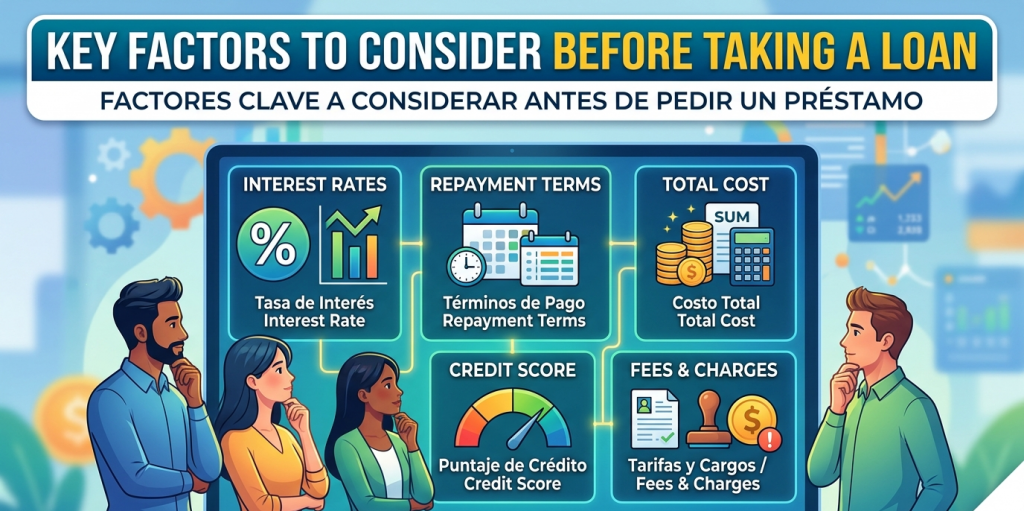
In this comprehensive guide, you will learn the key factors to consider before signing any loan agreement. You will learn about interest rates and APR, loan terms and amortization, fees and penalties, your credit score’s role, the difference between secured and unsecured loans, debt-to-income ratios, prepayment penalties, and how to compare loan offers. By the end, you will have a complete checklist to evaluate any loan before you sign.
The True Cost of Borrowing: Interest Rate vs. APR
The most obvious factor is the interest rate. This is the percentage the lender charges you for borrowing money. A lower interest rate means lower total cost. A higher interest rate means higher total cost.
But the interest rate is not the whole story. The annual percentage rate, or APR, includes not only the interest rate but also fees and other costs of borrowing. The APR is almost always higher than the interest rate. It is the true cost of the loan expressed as a yearly percentage.
For example, a loan might have an interest rate of ten percent. But if the lender charges a five percent origination fee, the APR might be twelve percent. The interest rate tells you what you pay in interest. The APR tells you what you pay in total.
Federal law requires lenders to disclose the APR before you sign a loan agreement. Always look at the APR, not just the interest rate. Two loans with the same interest rate can have very different APRs if one has higher fees.
The table below shows how different APRs affect the total cost of a ten thousand dollar loan over five years.
| APR | Monthly Payment | Total Interest Paid | Total Cost of Loan |
|---|---|---|---|
| 6% | $193 | $1,600 | $11,600 |
| 9% | $208 | $2,450 | $12,450 |
| 12% | $222 | $3,350 | $13,350 |
| 15% | $238 | $4,270 | $14,270 |
| 18% | $254 | $5,230 | $15,230 |
| 21% | $270 | $6,220 | $16,220 |
| 24% | $287 | $7,240 | $17,240 |
| 30% | $322 | $9,320 | $19,320 |
The difference between a six percent APR and a thirty percent APR on a ten thousand dollar loan is over seven thousand dollars in interest. That is money that could have been saved, invested, or spent on something you actually need. This is why shopping for the lowest APR is so important.
Loan Term: How Long Will You Be Paying?
The loan term is the length of time you have to repay the loan. Common terms are twelve months, twenty-four months, thirty-six months, forty-eight months, sixty months, and sometimes longer.
Longer terms mean lower monthly payments. A ten thousand dollar loan at ten percent over three years has a monthly payment of approximately three hundred twenty-three dollars. The same loan over five years has a monthly payment of approximately two hundred twelve dollars. The lower payment is easier to afford each month.
But longer terms also mean more total interest. The three-year loan costs approximately one thousand six hundred dollars in total interest. The five-year loan costs approximately two thousand seven hundred dollars in total interest. You pay over one thousand dollars more for the privilege of lower monthly payments.
Shorter terms mean higher monthly payments but much less total interest. If you can afford the higher payment, a shorter term is almost always better. You pay off the debt faster. You pay less interest. You become debt-free sooner.
The exception is if you have a very low interest rate. If you have a three percent auto loan, there is little benefit to paying it off early. You could invest the extra money and earn a higher return than the interest you are paying. But for most consumer loans at higher rates, shorter terms are better.
Some loans have variable terms. A variable-rate loan has an interest rate that can change over time, usually tied to an index like the prime rate. If interest rates rise, your payment rises. If interest rates fall, your payment falls. Variable-rate loans are riskier than fixed-rate loans. You might be able to afford the payment today but not if rates rise. For most borrowers, a fixed-rate loan is safer and easier to budget for.
Fees: The Hidden Costs of Borrowing
Fees can dramatically increase the cost of a loan. Many borrowers focus only on the interest rate and ignore fees. This is a mistake.
The origination fee is charged by the lender for processing the loan. It is typically one to eight percent of the loan amount. A five percent origination fee on a ten thousand dollar loan is five hundred dollars. That five hundred dollars is added to your balance or deducted from your disbursement. You pay interest on that five hundred dollars too.
The application fee is charged just for applying. Some lenders charge this fee regardless of whether you are approved. Avoid lenders who charge application fees. There are plenty of lenders who do not.
The prepayment penalty is charged if you pay off the loan early. This fee exists because the lender wants to collect the interest you would have paid over the full term. A prepayment penalty can be a flat fee or a percentage of the remaining balance. Avoid loans with prepayment penalties. You should never be punished for paying off debt early.
The late payment fee is charged if you pay after the due date. Late fees are typically twenty-five to forty dollars. Some lenders charge a late fee as a percentage of the missed payment. If you are late, the fee can add up quickly. Some lenders also report late payments to credit bureaus, damaging your credit score.
The returned payment fee is charged if your payment is returned for insufficient funds. This fee is similar to a bounced check fee, typically twenty-five to forty dollars. The lender may also report the returned payment to credit bureaus.
The statement fee is charged for paper statements. Some lenders charge one to three dollars per month for paper statements. Switch to electronic statements to avoid this fee.
The payoff fee is charged when you request a formal payoff quote to close the loan. Some lenders charge ten to twenty-five dollars for this service. This fee is usually avoidable by using online payoff tools.
The table below summarizes common loan fees and their typical amounts.
| Fee Type | Typical Amount | Avoidance Strategy |
|---|---|---|
| Origination fee | 1-8% of loan amount | Shop for lenders with no or low origination fees |
| Application fee | $25-$100 | Avoid; choose lenders without application fees |
| Prepayment penalty | Varies (flat fee or % of balance) | Avoid entirely; choose loans without this penalty |
| Late payment fee | $25-$40 | Set up autopay; pay on time |
| Returned payment fee | $25-$40 | Keep sufficient balance; use autopay |
| Statement fee | $1-$3 per month | Switch to electronic statements |
| Payoff fee | $10-$25 | Use online payoff tools instead of phone/paper |
Your Credit Score: The Key That Unlocks Better Rates
Your credit score is one of the most important factors in determining what loan terms you will receive. A higher credit score means lower interest rates. A lower credit score means higher interest rates or even denial.
Credit scores typically range from three hundred to eight hundred fifty. Scores above seven hundred forty are considered excellent. Scores below six hundred seventy are considered fair to poor. The difference between an excellent score and a fair score can be five percentage points or more on an interest rate.
On a ten thousand dollar loan over five years, the difference between a six percent APR and an eleven percent APR is over one thousand four hundred dollars in interest. That is the cost of having a fair credit score instead of an excellent one. On a mortgage, the difference can be tens of thousands of dollars.
Before applying for any loan, check your credit score. You can get a free credit report annually from AnnualCreditReport.com. Many credit card issuers and banks also provide free credit scores to customers. If your score is lower than you would like, consider waiting to apply for the loan until you can improve your score.
To improve your credit score, pay all bills on time. Reduce your credit card balances. Do not apply for new credit unnecessarily. Dispute any errors on your credit report. These actions take time, but they can save you thousands of dollars in interest.
Every loan application generates a hard inquiry on your credit report. Hard inquiries temporarily lower your credit score by a few points. Multiple inquiries in a short period can lower your score more significantly. When shopping for a loan, try to complete all applications within a two-week window. Credit scoring models treat multiple inquiries for the same type of loan as a single inquiry if they occur within a short period.
Secured vs. Unsecured Loans: What Are You Pledging?
A secured loan is backed by collateral. If you fail to repay the loan, the lender can take the collateral. A mortgage is secured by your house. An auto loan is secured by your car. A secured personal loan might be backed by your savings account or other assets.
Because secured loans are less risky for lenders, they typically have lower interest rates. A mortgage might have a six percent interest rate while an unsecured personal loan might have twelve percent. The trade-off is that you risk losing your collateral if you cannot make payments.
An unsecured loan has no collateral. The lender approves you based on your creditworthiness alone. If you fail to repay, the lender can sue you, garnish your wages, or send the debt to collections, but they cannot take a specific asset. Unsecured loans have higher interest rates because they are riskier for lenders.
Before taking a secured loan, ask yourself: Am I willing to lose this asset if I cannot make payments? If the answer is no, do not use that asset as collateral. Do not put your house at risk for a vacation. Do not put your car at risk for a consolidation loan.
Some loans are partially secured. A title loan uses your car title as collateral. These loans are extremely dangerous. Interest rates can exceed one hundred percent. Lenders may seize your car after a single missed payment. Avoid title loans entirely. The same goes for payday loans, which are not secured but have interest rates that can exceed four hundred percent. These products are designed to trap you in a cycle of debt.
Debt-to-Income Ratio: Can You Actually Afford the Payment?
Your debt-to-income ratio, or DTI, is the percentage of your monthly gross income that goes toward debt payments. Lenders use this ratio to determine whether you can afford a new loan. You should use it for the same purpose.
To calculate your DTI, add up all your monthly debt payments: mortgage or rent, car loans, student loans, credit card minimum payments, and any other existing loans. Do not include utilities, insurance, or groceries. Divide that total by your monthly gross income (income before taxes and deductions). Multiply by one hundred to get a percentage.
Most lenders prefer a DTI below forty-three percent. Some lenders will approve up to fifty percent. A DTI above fifty percent is dangerous. You have very little room for error. A job loss, a medical emergency, or a car repair could push you into default.
Even if a lender approves you with a high DTI, you should think carefully about whether you can actually afford the payment. The lender’s approval is based on averages and models. Your personal situation is unique. If your DTI is high, consider paying down existing debt before taking on new debt.
Your debt-to-income ratio does not include your other expenses like food, utilities, transportation, and healthcare. A DTI of forty percent might be affordable if you have low other expenses. The same DTI might be unaffordable if you have high medical bills or childcare costs. Be honest with yourself about your full budget.
Prepayment Penalties: The Trap for Responsible Borrowers
A prepayment penalty is a fee charged if you pay off your loan early. This fee exists because the lender expected to collect interest over the full term. When you pay early, the lender loses that expected interest. The prepayment penalty compensates the lender.
Prepayment penalties are most common on personal loans, auto loans, and some mortgages. They are less common on student loans and credit cards. Some states restrict or prohibit prepayment penalties. Check your state’s laws.
There are two types of prepayment penalties. A hard prepayment penalty applies if you pay off the loan early for any reason, including refinancing or selling the collateral. A soft prepayment penalty applies only if you refinance with a different lender but not if you pay from savings.
The penalty can be calculated as a percentage of the remaining balance, typically one to five percent, or as a flat fee. On a ten thousand dollar remaining balance, a five percent penalty is five hundred dollars.
You should avoid loans with prepayment penalties whenever possible. You should never be punished for paying off debt early. If you must take a loan with a prepayment penalty, understand the terms. How long does the penalty period last? Some penalties expire after one or two years. What is the penalty amount? Is it worth paying to refinance to a lower rate?
Fixed vs. Variable Interest Rates
A fixed interest rate stays the same for the entire life of the loan. Your monthly payment never changes. Fixed rates are predictable and easy to budget for. They are safer for borrowers.
A variable interest rate can change over time. The rate is tied to an index, typically the prime rate or SOFR. When the index goes up, your rate goes up. When the index goes down, your rate goes down. Variable rates often start lower than fixed rates, but they carry the risk of rising.
In 2026, after several years of high interest rates, the Federal Reserve is in a uncertain position. Rates may stay high. Rates may fall. Rates may even rise further. This uncertainty makes variable-rate loans riskier than usual.
Variable-rate loans can be a good choice if you plan to pay off the loan quickly. If you will repay in one to two years, the risk of a significant rate increase is low. You can benefit from the lower starting rate. For longer-term loans, fixed rates are safer.
Some loans have a hybrid structure. The rate is fixed for an initial period, then becomes variable. A five-year adjustable-rate mortgage might have a fixed rate for five years, then adjust annually. This can be a good compromise if you plan to sell or refinance before the adjustment period.
Your Purpose: Is This Loan Necessary?
Before considering any other factor, ask yourself the most important question: Do I actually need this loan?
Good debt is debt that increases your net worth or improves your financial future. A mortgage to buy a home is good debt. A student loan to pay for education that increases your earning potential is good debt. A loan to start or expand a business that generates income is good debt.
Bad debt is debt for consumption that does not increase your net worth. A loan for a vacation is bad debt. A loan for a wedding is bad debt. A loan for a new car when your current car works fine is bad debt. A loan to buy luxury goods you cannot afford is bad debt.
Some debt is in between. A loan to consolidate high-interest credit card debt can be good if it lowers your interest rate and you do not run up the cards again. A loan for necessary home repairs is good. A loan for cosmetic home improvements is questionable.
If you are taking a loan for a want rather than a need, consider waiting and saving instead. The interest you will pay is the cost of impatience. Is that cost worth it?
Comparing Loan Offers: A Systematic Approach
Do not accept the first loan offer you receive. Shop around. Compare multiple lenders. Use a systematic approach.
Step one is to check your credit score. Know where you stand before you apply. If your score is low, work on improving it before applying.
Step two is to pre-qualify with multiple lenders. Pre-qualification uses a soft credit inquiry, which does not affect your credit score. Lenders will give you estimated rates and terms. Compare these estimates.
Step three is to compare APRs, not interest rates. The APR includes fees and gives you the true cost of the loan.
Step four is to compare loan terms. A lower monthly payment might mean a longer term and more total interest. Calculate the total cost of each loan option.
Step five is to check fees. Origination fees, prepayment penalties, late fees. Add these to your comparison.
Step six is to read reviews. Is the lender reputable? Do customers report hidden fees or poor customer service? Check the Better Business Bureau and consumer review sites.
Step seven is to formally apply with the best one or two lenders. This will generate a hard inquiry. Complete the applications within a short period to minimize credit score impact.
Step eight is to read the final loan agreement carefully before signing. Do not just skim. Read every word. If something is unclear, ask. If the lender cannot explain it clearly, walk away.
The Bottom Line
Taking a loan is a serious financial decision. The difference between a good loan and a bad loan can be thousands of dollars. The difference between being able to afford a loan and being trapped by a loan can be years of financial stress.
Before you sign any loan agreement, work through this checklist. Know the APR, not just the interest rate. Understand the loan term and how it affects total interest. Identify all fees, especially origination fees and prepayment penalties. Check your credit score and improve it if needed. Decide whether you are willing to pledge collateral. Calculate your debt-to-income ratio honestly. Choose fixed rates over variable rates for long-term loans. Ask yourself whether the loan is truly necessary. Compare offers from multiple lenders.
A loan is a tool. Used wisely, it can help you buy a home, pay for education, or consolidate debt. Used unwisely, it can trap you in a cycle of payments that lasts for years. The choice is yours. Make it with your eyes open.
Your Next Step: If you are considering a loan, write down the purpose, the amount, and the timeline. Check your credit score. Pre-qualify with three lenders. Compare their APRs, terms, and fees. Calculate the total cost of each option. Then decide whether the loan is worth that cost. If it is, choose the best offer. If not, wait and save.
Disclaimer: This content is for educational purposes only and does not constitute financial advice. Loan terms, interest rates, and fees vary by lender and change over time. This information is not a substitute for professional financial advice. Consult a financial advisor or credit counselor before making borrowing decisions.