Imagine you have just received your first paycheck. You hold the paper check in your hands. You know you need to put this money somewhere safe. But where? Your friend mentions a checking account. Your parent mentions a savings account. Your coworker mentions a money market account. A sponsored social media post mentions a certificate of deposit. You have no idea which one is right for you.
This confusion is not your fault. The banking industry has done a poor job of explaining the differences between account types. They use jargon. They bury important details in fine print. They make simple concepts seem complicated.
Yet understanding the types of bank accounts and their features is essential for every adult. The choices you make about where to keep your money affect your fees, your interest earnings, your access to cash, and your financial security. The right account can save you hundreds of dollars per year. The wrong account can cost you hundreds.
In this comprehensive guide, you will learn about every major type of bank account available in 2026. You will learn what each account is designed for, what features matter most, what fees to watch for, and how to choose the right combination of accounts for your specific situation. By the end, you will never be confused about where to put your money again.
The Banking Landscape in 2026
Before diving into specific account types, it is important to understand how banking has changed. The traditional model of walking into a local branch and speaking with a teller is no longer the only option. In fact, for many people, it is no longer the primary option.
Online banks have matured significantly. They offer higher interest rates on savings because they do not pay for physical branches. They offer robust mobile apps with check deposit by photograph, bill pay, and instant peer-to-peer transfers. Many have no monthly fees at all. The trade-off is that you cannot deposit cash easily, and you cannot speak to a teller in person.
Traditional brick-and-mortar banks still have advantages. You can deposit cash. You can get a cashier’s check immediately. You can speak to a banker face to face about complex issues. You can use a safe deposit box. These features matter to some people, especially small business owners and older adults.
Credit unions are another option. They are not-for-profit organizations owned by their members. They often offer lower fees, better interest rates on loans, and more personalized service than banks. The trade-off is that you must qualify for membership, usually through employment, geographic location, or association membership. In 2026, most credit unions have expanded their membership criteria, making them accessible to nearly everyone.
The best approach for most people is a combination. Use an online bank for high-yield savings. Use a local credit union or brick-and-mortar bank for checking and cash deposits. Keep the minimum required in the local account to avoid fees. Keep the rest in the online account earning interest.
Checking Accounts: The Workhorse of Daily Banking
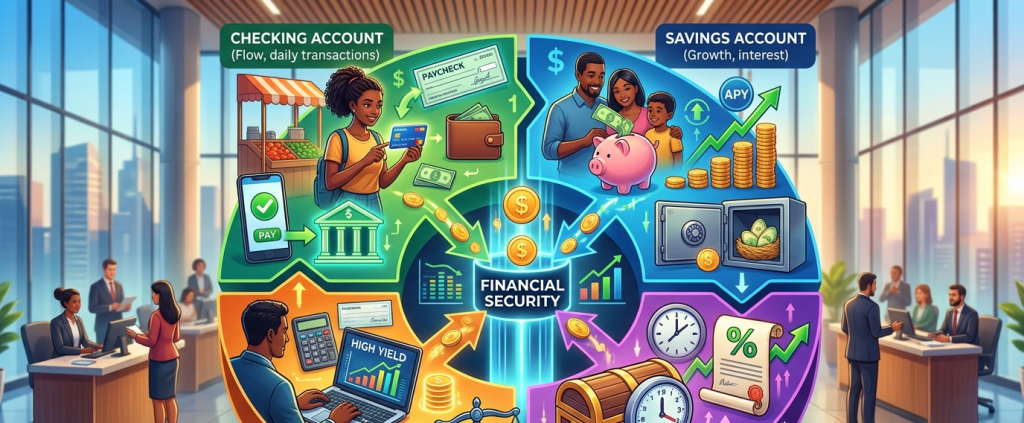
A checking account is designed for frequent transactions. You use it to receive your paycheck, pay your bills, withdraw cash from ATMs, make purchases with a debit card, and write checks. It is the central hub of your financial life.
The primary feature of a checking account is unlimited transactions. You can deposit money, withdraw money, transfer money, and make purchases as many times as you want. Savings accounts, by contrast, are limited to six withdrawals per month under federal regulations.
Checking accounts come in several varieties. A standard checking account has no frills and a low monthly fee that can usually be waived by maintaining a minimum balance or setting up direct deposit. This is the most common type of account.
An interest-bearing checking account pays a small amount of interest on your balance. The interest rate is typically very low, often less than 0.10 percent. The account may require a higher minimum balance to avoid fees. For most people, the interest earned is not worth the higher balance requirement.
A high-yield checking account is offered by some online banks and credit unions. These accounts pay significantly higher interest, sometimes two to three percent, but they come with conditions. You may need to make a minimum number of debit card transactions each month, receive electronic statements, and have direct deposit. If you fail to meet the conditions, you earn little or no interest.
A student checking account is designed for young people. It typically has no monthly fee, no minimum balance requirement, and features like mobile check deposit and budgeting tools. These accounts often convert to standard checking accounts after you reach a certain age, usually twenty-four or twenty-five.
A senior checking account is designed for people over a certain age, typically fifty-five or sixty. It offers features like free checks, no monthly fees, and higher interest rates on balances. Some also offer fraud protection services tailored to older adults.
When choosing a checking account, prioritize low fees, convenient ATM access, a good mobile app, and fraud protection. Interest rates are less important because you should not keep large balances in checking. Your checking account is for spending, not saving. Keep only what you need for monthly expenses. Move the rest to savings.
Savings Accounts: Growing Your Safe Money
A savings account is designed for money you want to keep safe but accessible. You use it for your emergency fund, for short-term savings goals like a vacation or a down payment, and for money you do not need for daily spending but might need on short notice.
The primary feature of a savings account is interest. The bank pays you for the right to use your money. In 2026, after several years of rising interest rates, savings account yields are attractive. The best high-yield savings accounts from online banks offer four to five percent annual percentage yield. Traditional brick-and-mortar banks still offer near-zero interest on standard savings accounts. The difference is enormous. On a ten thousand dollar balance, a five percent account earns five hundred dollars per year. A 0.10 percent account earns ten dollars per year.
The trade-off for higher interest is accessibility. High-yield savings accounts are typically offered by online banks. Transferring money from an online savings account to your checking account can take one to three business days. This is fine for an emergency fund. It is not fine for money you need immediately.
Savings accounts have withdrawal limits. Under federal Regulation D, savings accounts are limited to six withdrawals per month. If you exceed this limit, the bank may charge a fee or convert your account to checking. This limit does not apply to withdrawals made in person at a branch or at an ATM. It applies to online transfers, automatic transfers, and check writing.
A standard savings account is the baseline. It pays low interest, has low or no fees, and is offered by almost every bank. This account is useful only if you need to keep savings at the same bank as your checking for convenience. For serious saving, use a high-yield account elsewhere.
A high-yield savings account is the best choice for most people’s emergency funds and short-term savings. These accounts are offered by online banks like Ally, Marcus, Discover, and Capital One 360. They pay competitive interest rates. They have no monthly fees. They are FDIC insured up to two hundred fifty thousand dollars. The only downside is the one to three day transfer time.
A specialty savings account is designed for a specific purpose. A Christmas club account automatically deducts a set amount from your checking each week and pays it out in November. A health savings account, or HSA, is a tax-advantaged account for medical expenses. An individual development account, or IDA, matches savings for low-income individuals to buy a home, start a business, or pay for education. These accounts are useful in specific situations but are not necessary for most people.
When choosing a savings account, prioritize the interest rate, the monthly fees, and the ease of transferring money to your checking account. Do not worry about ATM access or check writing. You will not need these features for a savings account.
Money Market Accounts: The Hybrid Option
A money market account is a hybrid between a checking account and a savings account. It pays higher interest than a standard savings account. It also offers checking features like a debit card and check writing.
Money market accounts are often confused with money market funds. They are different. A money market account is a bank account insured by the FDIC up to two hundred fifty thousand dollars. A money market fund is an investment product that is not FDIC insured and can lose value.
The interest rate on a money market account is typically higher than a standard savings account but lower than a high-yield savings account. In 2026, money market accounts at competitive banks pay three to four percent. The best high-yield savings accounts pay four to five percent.
Money market accounts have higher minimum balance requirements than savings accounts. A typical money market account might require a minimum balance of one thousand to twenty-five hundred dollars to avoid a monthly fee. If your balance falls below the minimum, you may be charged a fee of ten to fifteen dollars per month.
Money market accounts offer limited checking features. You may receive a debit card. You may be able to write checks, usually up to three to six per month. These features make a money market account useful for holding money that you might need to access quickly but not for daily spending.
For most people, a high-yield savings account is a better choice than a money market account. The interest rate is higher. The minimum balance requirements are lower. The only advantage of a money market account is the checking features. If you need to write checks from your savings, a money market account makes sense. Otherwise, stick with high-yield savings.
Certificates of Deposit: Locking in Rates
A certificate of deposit, or CD, is a time deposit. You agree to leave your money in the bank for a fixed period, called the term. In exchange, the bank pays you a higher interest rate than a savings account. If you withdraw the money before the term ends, you pay a penalty, typically several months of interest.
CD terms range from three months to five years. Longer terms generally pay higher interest rates, but not always. When the Federal Reserve is expected to cut rates, longer-term CDs may pay lower rates than shorter-term CDs because banks do not want to lock in high rates for many years.
In 2026, CD rates are attractive. After several years of high interest rates, a one-year CD might pay four and a half to five percent. A five-year CD might pay four to four and a half percent. The yield curve is flat or slightly inverted, meaning longer terms do not pay significantly more than shorter terms.
A traditional CD is the standard type. You deposit a lump sum. You choose a term. You earn a fixed interest rate. At maturity, you can withdraw the money or roll it into a new CD. The penalty for early withdrawal is typically three to six months of interest.
A no-penalty CD allows you to withdraw your money before maturity without paying a penalty. The trade-off is a lower interest rate, typically 0.25 to 0.50 percent less than a traditional CD. This is a good choice if you are not sure whether you will need the money before the term ends.
A step-up CD automatically increases its interest rate at predetermined intervals. If rates rise, your CD rate rises with them. The starting rate is typically lower than a traditional CD. This is a good choice if you believe interest rates will rise during your CD term.
A bump-up CD allows you to request a one-time rate increase if the bank’s rates go up during your term. Like a step-up CD, the starting rate is lower. This is also a good choice for a rising rate environment.
A jumbo CD requires a larger minimum deposit, typically one hundred thousand dollars or more. It pays a slightly higher interest rate than a standard CD. Jumbo CDs are for wealthy individuals and institutions.
CDs are best for money you know you will not need for a specific period. If you are saving for a down payment on a house you will buy in two years, a two-year CD is a good choice. If you are building an emergency fund, do not use a CD. You may need the money on short notice, and the early withdrawal penalty would defeat the purpose.
The Table: Comparing Account Types at a Glance
The table below summarizes the key features of each major account type as of 2026.
| Account Type | Primary Purpose | Typical Interest Rate | Minimum Balance | Monthly Fee | FDIC Insured | Best For |
|---|---|---|---|---|---|---|
| Standard Checking | Daily transactions | 0.01-0.10% | $0-$100 | Often waivable | Yes | Everyday spending, bill payment |
| Interest Checking | Daily transactions with small interest | 0.05-0.50% | $500-$1,500 | Often waivable | Yes | Those who keep higher checking balances |
| High-Yield Checking | Daily transactions with high interest (with conditions) | 1-3% | $0-$1,000 | Often waivable with activity | Yes | Heavy debit card users |
| Standard Savings | Short-term savings, emergency fund | 0.01-0.50% | $0-$500 | Often waivable | Yes | Convenience at same bank as checking |
| High-Yield Savings | Emergency fund, short-term goals | 4-5% | $0-$100 | None (online banks) | Yes | Most people’s primary savings |
| Money Market | Hybrid savings/checking | 3-4% | $1,000-$2,500 | Often waivable | Yes | Those who need check writing from savings |
| Traditional CD | Locked savings for fixed term | 4-5% (1-year) | $500-$1,000 | None (early withdrawal penalty) | Yes | Known future expenses (down payment, etc.) |
| No-Penalty CD | Locked savings with flexibility | 3.5-4.5% | $500-$1,000 | None (no penalty) | Yes | Those unsure about timing |
How Many Accounts Should You Have?
Most people need at least two accounts. Some need three or four. Few need more than four.
The minimum is one checking account and one savings account. The checking account receives your paycheck and pays your bills. The savings account holds your emergency fund and short-term savings. Keep the checking balance low. Keep the savings balance higher.
A better setup is two checking accounts and one savings account. Use one checking account for fixed expenses like rent, utilities, and loan payments. Use the other checking account for variable spending like groceries, dining out, and entertainment. This separation makes budgeting easier. You never accidentally spend money that is needed for a bill.
An even better setup adds a second savings account. Use one savings account for your emergency fund. Use the other savings account for specific goals like a vacation, a new car, or a down payment. Keeping goal money separate from emergency money helps you track progress and reduces the temptation to dip into your emergency fund for non-emergencies.
Some people benefit from a CD ladder. A CD ladder involves opening multiple CDs with different maturity dates. For example, you might open a one-year CD, a two-year CD, a three-year CD, a four-year CD, and a five-year CD. As each CD matures, you reinvest it in a new five-year CD. This strategy provides higher interest rates than a savings account while ensuring that some money becomes available each year.
Do not open accounts you do not need. Each account is a potential source of fees. Each account requires monitoring. Each account adds complexity to your financial life. Start with the minimum. Add accounts only when you have a clear reason to do so.
Common Fees to Avoid
Banks make money from fees. You can avoid most fees by choosing the right accounts and managing them properly.
The monthly maintenance fee is the most common fee. It is a flat amount, typically five to fifteen dollars per month, charged just for having the account. These fees are almost always waivable. Common waivers include maintaining a minimum balance, setting up direct deposit, or making a minimum number of debit card transactions. If your bank charges a monthly fee that you cannot waive, switch banks.
The overdraft fee is charged when you spend more money than you have in your checking account. Overdraft fees are typically thirty to thirty-five dollars per occurrence. Some banks charge multiple overdraft fees per day. The best way to avoid overdraft fees is to opt out of overdraft coverage. If you opt out, your debit card will simply be declined when you do not have enough money. You cannot be charged a fee for a declined transaction.
The ATM fee is charged when you use an ATM outside your bank’s network. You may be charged two fees: one from your bank and one from the ATM owner. To avoid ATM fees, use only in-network ATMs. Many online banks reimburse a certain amount of out-of-network ATM fees each month. If you use cash frequently, choose a bank with a large ATM network or a generous reimbursement policy.
The minimum balance fee is charged when your balance falls below a required level. This fee is common on money market accounts and interest-bearing checking accounts. To avoid it, keep your balance above the minimum or switch to an account without a minimum balance requirement.
The paper statement fee is charged if you request paper statements instead of electronic statements. This fee is easily avoided by switching to electronic statements. You will still have access to your statements online. You can print them yourself if needed.
Choosing the Right Bank
Once you understand the account types, you must choose which bank to use. The best bank for you depends on your needs.
If you value high interest rates and low fees above all else, choose an online bank like Ally, Marcus, Discover, or Capital One 360. These banks offer the best savings rates. They offer free checking. They reimburse ATM fees. The trade-off is that you cannot deposit cash easily and there are no physical branches.
If you value physical branches and in-person service, choose a local credit union or a regional bank. Credit unions often have lower fees and better rates than large national banks. They also have shared branching networks, allowing you to use other credit unions’ branches nationwide. Large national banks like Chase, Bank of America, and Wells Fargo have the most branches and ATMs but generally offer lower interest rates and higher fees.
If you are a student or a young adult, look for banks with student accounts. These accounts have no fees and low minimum balances. Many online banks are also excellent for young people because of their mobile apps and fee structures.
If you are a retiree, look for banks with senior accounts. These accounts offer free checks, no monthly fees, and sometimes higher interest rates. Credit unions are often a good choice for retirees because of their personalized service.
The best strategy for most people is to use two banks. Use an online bank for high-yield savings. Use a local credit union or a large national bank for checking and cash deposits. Keep the minimum required in the local account to avoid fees. Keep the rest in the online account earning interest.
Conclusion
Understanding the types of bank accounts and their features is essential for managing your money effectively. Each account type serves a different purpose. Checking accounts are for daily spending. Savings accounts are for emergency funds and short-term goals. Money market accounts are a hybrid. Certificates of deposit are for money you can lock away for a fixed period.
Do not use the wrong account for the wrong purpose. Do not keep your emergency fund in a checking account earning no interest. Do not put your rent money in a CD where you cannot access it. Do not pay monthly fees when you could avoid them by switching banks.
The best setup for most people is a high-yield savings account at an online bank for the emergency fund and short-term goals, plus a no-fee checking account at a local credit union or national bank for daily spending and cash deposits. Add a CD ladder for money you know you will not need for one to five years.
Review your accounts annually. Are you paying any fees you could avoid? Could you be earning a higher interest rate elsewhere? Are your accounts still meeting your needs? The banking industry changes. Your life changes. Your accounts should change too.
Your Next Step: Open your bank statements from the past month. Identify every fee you paid. Call your bank and ask which fees can be waived. If they cannot waive the fees, open a new account at a different bank. Move your money. Close the old account. Then set a calendar reminder to review your accounts again in one year.
Disclaimer: This content is for educational purposes only and does not constitute financial advice. Interest rates, fees, and account features vary by bank and change over time. Always read the terms and conditions before opening any bank account. Consult a financial advisor for advice specific to your situation.