The year is 1993. A new financial product launches on the American Stock Exchange. It is called the Standard & Poor’s Depositary Receipts, nicknamed SPDRs or “Spiders.” It tracks the S&P 500. Investors can buy and sell it throughout the day, just like a stock. It holds a basket of the five hundred largest US companies. It costs a fraction of what mutual funds charge.
Most investors ignore it. It seems too simple. Why buy one thing that owns five hundred companies when you could pick individual stocks? Why pay even a small fee when you could trade for free?
Thirty-three years later, that humble product has revolutionized investing. The SPDR S&P 500 ETF now has over four hundred billion dollars in assets. The global ETF industry has grown to over twelve trillion dollars. ETFs have democratized investing, giving ordinary people access to the same low-cost, diversified portfolios that once were available only to institutions.
Yet millions of investors still do not fully understand what ETFs are and how they work. They buy them because their friends do. They hold them because their advisors recommend them. But they could not explain the difference between an ETF and a mutual fund, or how an ETF maintains its price, or why some ETFs are dangerous while others are safe.
Understanding what are ETFs and how do they work is essential for any modern investor. In this comprehensive guide, we will strip away the complexity. You will learn the definition of an ETF, how it differs from mutual funds and closed-end funds, the mechanics of creation and redemption that keep ETF prices in line, the different types of ETFs available, the costs and risks you need to know, and—most critically—how to use ETFs to build a low-cost, diversified, tax-efficient portfolio.
The Simple Definition: What an ETF Actually Is
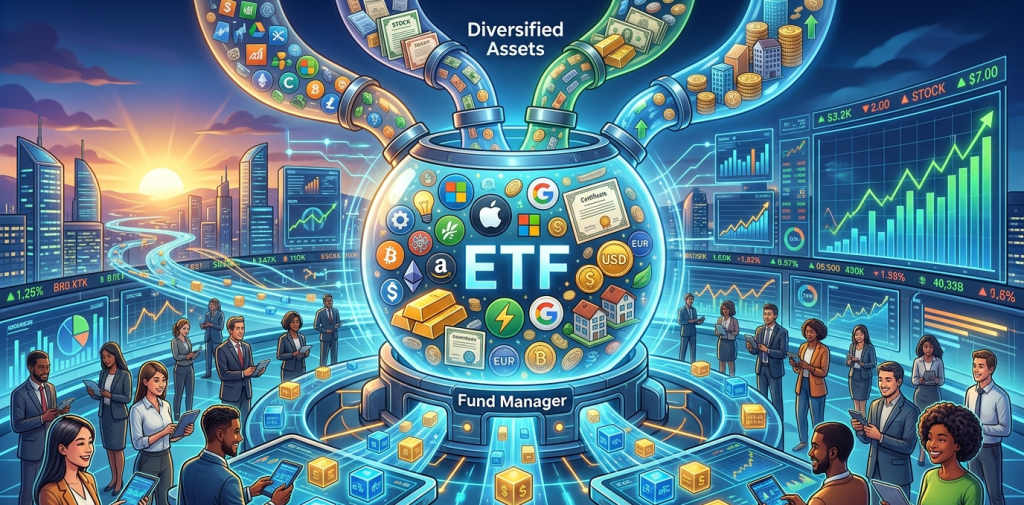
An exchange-traded fund, or ETF, is a type of investment fund that holds a basket of securities—stocks, bonds, commodities, or other assets—and trades on a stock exchange just like an individual stock. When you buy one share of an ETF, you are buying a tiny slice of the entire basket.
The simplest analogy is a basket of fruit. Instead of buying an apple, an orange, a banana, and a grapefruit individually, you buy a basket that contains all four. You get diversification in a single purchase. The ETF is the basket. The individual securities are the fruit.
ETFs have two key characteristics that distinguish them from other investment products. First, they are traded throughout the day on an exchange. You can buy or sell them at any time the market is open, at whatever price the market is offering. Second, they track an underlying index or asset class. The SPDR S&P 500 ETF tracks the S&P 500. When the index rises, the ETF rises. When the index falls, the ETF falls.
This combination of intraday trading and passive indexing is the innovation that made ETFs revolutionary. Before ETFs, investors who wanted diversification had to buy mutual funds, which priced only once per day after the market closed. Or they had to buy individual stocks, which required extensive research and large amounts of capital to achieve diversification. ETFs solved both problems.
In 2026, there are over nine thousand ETFs globally, covering every imaginable asset class and strategy. There are ETFs that track the entire US stock market, ETFs that track only technology companies, ETFs that track only companies with low carbon emissions, ETFs that track the price of Bitcoin, ETFs that use leverage to double the daily return of the Nasdaq, and ETFs that do the opposite, shorting the market. The variety is staggering. The quality varies enormously.
The Critical Distinction: ETFs vs. Mutual Funds
Most investors confuse ETFs with mutual funds. The confusion is understandable. Both are funds that hold baskets of securities. Both offer diversification. But the differences are significant and matter for your returns.
The table below summarizes the key differences between ETFs and traditional mutual funds.
| Feature | ETFs | Mutual Funds |
|---|---|---|
| Trading | Intraday, on exchange, at market prices | Once per day, after market closes, at NAV |
| Minimum investment | Price of one share (often $20-$500) | Often $1,000 to $3,000 |
| Fees (expense ratios) | Very low (0.03% to 0.30% typical) | Low to high (0.05% to 1.50% typical) |
| Tax efficiency | Highly tax-efficient | Less tax-efficient (capital gains distributions) |
| Active vs passive | Mostly passive (index tracking) | Mostly active (manager picks stocks) |
| Purchasing process | Buy/sell like stock through brokerage | Buy/sell directly from fund company |
| Dividend treatment | Dividends paid in cash or reinvested | Dividends typically reinvested automatically |
| Fractional shares | Varies by broker (many now offer) | Standard |
The most important difference for most investors is cost. The average passively managed index ETF charges less than 0.10% per year. The average actively managed mutual fund charges around 1.00% per year. Over thirty years, that difference consumes more than a quarter of your returns. A 0.10% fee leaves you with ninety-seven percent of the market’s returns. A 1.00% fee leaves you with seventy-four percent.
The second most important difference is tax efficiency. Mutual funds are required to distribute capital gains to shareholders when the manager sells securities within the fund. These distributions are taxable even if you did not sell any shares of the fund. ETFs, because of their unique creation and redemption mechanism, rarely distribute capital gains. This makes ETFs significantly more tax-efficient than mutual funds, especially in taxable brokerage accounts.
In 2026, with tax rates scheduled to rise, tax efficiency is more important than ever. For taxable accounts, ETFs are almost always preferable to mutual funds. For retirement accounts like IRAs and 401(k)s, where taxes are not an immediate concern, the difference is less important. But the lower fees of ETFs still favor them.
The Magic Mechanism: Creation and Redemption
The most confusing aspect of ETFs is also the most important for understanding how they work. It is the creation and redemption mechanism, and it is the secret sauce that makes ETFs function.
Every ETF has two distinct players. The first is the retail investor, who buys and sells small numbers of shares on the exchange. The second is the authorized participant, which is typically a large institutional investor like a bank or a market maker. The authorized participant is the link between the ETF shares on the exchange and the underlying securities that the ETF holds.
When demand for an ETF is high and the ETF’s market price rises above the value of its underlying holdings, the authorized participant steps in. They buy the underlying securities, deliver them to the ETF issuer, and receive newly created ETF shares. They then sell those shares on the exchange for a profit. This process is called creation. It increases the supply of ETF shares, which pushes the market price back down toward the underlying value.
When demand for an ETF is low and the ETF’s market price falls below the value of its underlying holdings, the authorized participant does the reverse. They buy ETF shares on the exchange, redeem them with the ETF issuer, and receive the underlying securities. They then sell those securities for a profit. This process is called redemption. It decreases the supply of ETF shares, which pushes the market price back up toward the underlying value.
This creation and redemption mechanism is what keeps the ETF’s market price almost perfectly aligned with the value of its underlying holdings. The mechanism is automated, continuous, and efficient. It happens in the background without any action from retail investors.
The mechanism also explains why ETFs are tax-efficient. When an authorized participant redeems shares, they receive the underlying securities. The ETF issuer does not have to sell those securities on the open market, so no capital gains are realized. The tax burden is transferred to the authorized participant, which is typically a tax-exempt institution.
In 2026, the creation and redemption mechanism is more important than ever because ETFs have grown so large. Some ETFs now hold hundreds of billions of dollars in assets. The mechanism ensures that these giants remain liquid and accurately priced.
The Main Types of ETFs
Not all ETFs are created equal. The term “ETF” covers a vast range of products with different strategies, risks, and costs. Understanding the different types is essential for choosing the right ETF for your portfolio.
The first and most important category is broad market index ETFs. These track major indices like the S&P 500, the total US stock market, or the global stock market. Examples include VTI (Vanguard Total Stock Market), VOO (Vanguard S&P 500), and VT (Vanguard Total World Stock). These ETFs are cheap, diversified, and suitable as the core of any long-term portfolio. Their expense ratios are often below 0.10%.
The second category is sector and industry ETFs. These track specific parts of the market, such as technology, healthcare, energy, or financials. Examples include XLK (Technology Select Sector SPDR Fund) and XLE (Energy Select Sector SPDR Fund). These ETFs are useful for tilting your portfolio toward sectors you believe will outperform. But they are less diversified than broad market ETFs and carry higher risk.
The third category is bond ETFs. These track bond indices, including US Treasury bonds, corporate bonds, municipal bonds, and international bonds. Examples include BND (Vanguard Total Bond Market) and AGG (iShares Core US Aggregate Bond). Bond ETFs provide income and stability. They are an essential part of a diversified portfolio, especially for investors nearing retirement.
The fourth category is international ETFs. These track stock markets outside the United States. Examples include VXUS (Vanguard Total International Stock) and EEM (iShares MSCI Emerging Markets). International diversification protects you against the risk that the US market underperforms for a decade or more.
The fifth category is thematic and actively managed ETFs. These track narrow themes like robotics, clean energy, or genomics. They are often actively managed, meaning a manager picks stocks rather than tracking an index. Examples include ARKK (ARK Innovation ETF) and TAN (Invesco Solar ETF). These ETFs are expensive, concentrated, and risky. They should be used only by sophisticated investors who understand the specific theme and are willing to accept high volatility.
The sixth category is leveraged and inverse ETFs. These use derivatives to double, triple, or even inverse the daily return of an underlying index. A 3x leveraged Nasdaq ETF will rise approximately three percent for every one percent the Nasdaq rises. It will also fall three percent for every one percent the Nasdaq falls. These ETFs are dangerous. They are designed for short-term trading, not long-term holding. Decay and compounding effects cause them to lose value over time even if the underlying index is flat. Most retail investors should avoid them entirely.
In 2026, the most dangerous ETFs are the leveraged and inverse products. They have become popular on social media, where traders post screenshots of enormous gains. What they do not show are the enormous losses. If you are a long-term investor, stick with broad market index ETFs. They are boring. They are safe. They work.
The Real Costs of ETF Investing
The expense ratio is the most visible cost of ETF investing. It is the annual fee that the ETF issuer charges to manage the fund. For a broad market index ETF like VOO, the expense ratio is 0.03%. That means for every ten thousand dollars you have invested, you pay three dollars per year in fees.
But expense ratios are not the only cost. The bid-ask spread is the difference between the price at which you can buy an ETF and the price at which you can sell it. For highly liquid ETFs like VOO, the spread is often one cent, or 0.01%. For illiquid ETFs tracking obscure themes, the spread can be 1% or more. That spread is a cost you pay every time you trade.
The premium or discount is the difference between the ETF’s market price and the value of its underlying holdings. For most ETFs, the creation and redemption mechanism keeps the premium or discount close to zero. But for illiquid ETFs or during periods of market stress, premiums and discounts can widen. Buying an ETF at a 2% premium means you are overpaying by 2%.
Commissions are the fees your broker charges to trade. Most major brokers have eliminated commissions on ETFs. But some still charge. If your broker charges commissions, factor them into your costs.
The hidden cost is the impact of your own trading behavior. The most expensive mistake ETF investors make is trading too frequently. Every trade incurs the bid-ask spread. Frequent trading also triggers short-term capital gains taxes. The best strategy for most ETF investors is to buy and hold. Set up automatic contributions. Rebalance once per year. Otherwise, do nothing.
In 2026, with commission-free trading at most brokers and expense ratios at all-time lows, the costs of ETF investing are lower than ever. But the behavioral costs remain. Do not let low explicit costs encourage you to trade excessively.
How to Build an ETF Portfolio
Building an ETF portfolio is simple. You need three to seven ETFs, depending on how much complexity you want. More ETFs do not mean better diversification. Three well-chosen ETFs can provide all the diversification you need.
The simplest portfolio is a single ETF: a target-date retirement fund that automatically adjusts its asset allocation as you age. These funds are available from Vanguard, Fidelity, Schwab, and others. They are perfect for investors who want a completely hands-off approach.
The classic three-fund portfolio consists of a total US stock market ETF, a total international stock market ETF, and a total US bond market ETF. The allocation depends on your age and risk tolerance. A thirty-year-old might use 60% VTI, 30% VXUS, and 10% BND. A sixty-year-old might use 30% VTI, 20% VXUS, and 50% BND.
The five-fund portfolio adds a small-cap value ETF and a real estate ETF for additional diversification. Small-cap value stocks have historically outperformed the broad market over long periods. Real estate provides income and inflation protection. But these additions are optional. The three-fund portfolio is sufficient for most investors.
In 2026, with international stocks relatively cheap compared to US stocks, consider a higher allocation to VXUS than historical averages. The US market has outperformed for more than a decade. Mean reversion suggests that international markets may outperform in the coming decade.
Common ETF Mistakes to Avoid
The first mistake is chasing past performance. Investors buy ETFs that have performed well recently. Those ETFs then revert to the mean and underperform. The cycle repeats. Buy broad market index ETFs instead. They will never be the best performer, but they will never be the worst.
The second mistake is using leveraged or inverse ETFs for long-term holding. These products are designed for daily trading. Due to compounding and decay, a 3x leveraged ETF held for a year will almost certainly underperform three times the index’s return, often by a wide margin. If you want leverage, use futures or options. Do not hold leveraged ETFs for more than a few days.
The third mistake is ignoring taxes. In taxable accounts, realize losses to offset gains. Hold tax-efficient ETFs like VTI and VXUS. Avoid high-turnover ETFs that generate frequent capital gains distributions.
The fourth mistake is trading too frequently. Every trade incurs the bid-ask spread. Frequent trading also increases the likelihood of behavioral errors. Set up automatic contributions and rebalance once per year. Otherwise, do nothing.
The fifth mistake is investing in thematic ETFs without understanding the theme. Thematic ETFs like clean energy or robotics are concentrated and risky. They often have high expense ratios. Most investors would be better served by a broad market ETF that already includes those sectors.
Conclusion
ETFs are one of the greatest innovations in the history of investing. They have democratized access to low-cost, diversified portfolios. They have made it possible for ordinary people to invest like institutions. They have driven fees to zero and transparency to one hundred percent.
Understanding what ETFs are and how they work is essential for any modern investor. You now know the definition. You know the difference between ETFs and mutual funds. You know the creation and redemption mechanism that keeps ETF prices accurate. You know the different types of ETFs and which to use and which to avoid. You know the real costs. You know how to build a portfolio. You know the common mistakes to avoid.
The path forward is simple. Open a brokerage account. Choose a three-fund portfolio of low-cost, broad market index ETFs. Set up automatic monthly contributions. Enable dividend reinvestment. Rebalance once per year. Ignore the noise. Stay the course.
The ETF industry will continue to innovate. New products will launch. Some will be useful. Most will be marketing gimmicks. Your job is to ignore the gimmicks and stick with the core principles. Low costs. Broad diversification. Long-term holding. That is the ETF investor’s path to wealth.
Your Next Step: Open your brokerage account today. Look at your holdings. Are you paying more than 0.20% in expense ratios? If yes, consider switching to lower-cost ETFs. Are you holding leveraged or inverse ETFs? If yes, sell them today. Are you trading frequently? If yes, stop. Set up automatic contributions. Then close the app. Do not check it again until next month.
Disclaimer: This content is for educational purposes only and does not constitute financial advice. ETFs involve risks, including the potential loss of principal. Leveraged and inverse ETFs are highly risky and not suitable for long-term holding. Past performance does not guarantee future results. Consult a licensed financial advisor before making investment decisions.