The year is 2021. A young professional opens a brokerage account for the first time. He has saved five thousand dollars. He is excited. He has been watching YouTube videos about investing. He knows that stocks go up. He knows that he should buy low and sell high. He is ready.
He buys what his friends are buying. Cryptocurrency. Meme stocks. Options. Within three months, his five thousand dollars becomes fifteen thousand dollars. He feels like a genius. He quits his job to trade full time.
The year is 2022. The market turns. His fifteen thousand dollars becomes three thousand dollars. He loses his apartment. He moves back in with his parents. He wishes he had never heard of investing.
This story is not hypothetical. It happened to thousands of young investors during the pandemic trading boom. It happens every cycle. New investors make the same mistakes. They chase hot stocks. They trade too frequently. They use leverage. They panic sell. They learn the hard way that investing is not a get-rich-quick scheme.
The good news is that you do not have to learn these lessons the hard way. The mistakes are predictable. They are avoidable. You can learn from the pain of others rather than experiencing it yourself.
Understanding the common mistakes new investors should avoid is the fastest way to accelerate your investing education. In this comprehensive guide, you will learn the ten most destructive mistakes new investors make, why they make them, and how to avoid each one. By the end, you will be better prepared than ninety percent of new investors who enter the market each year.
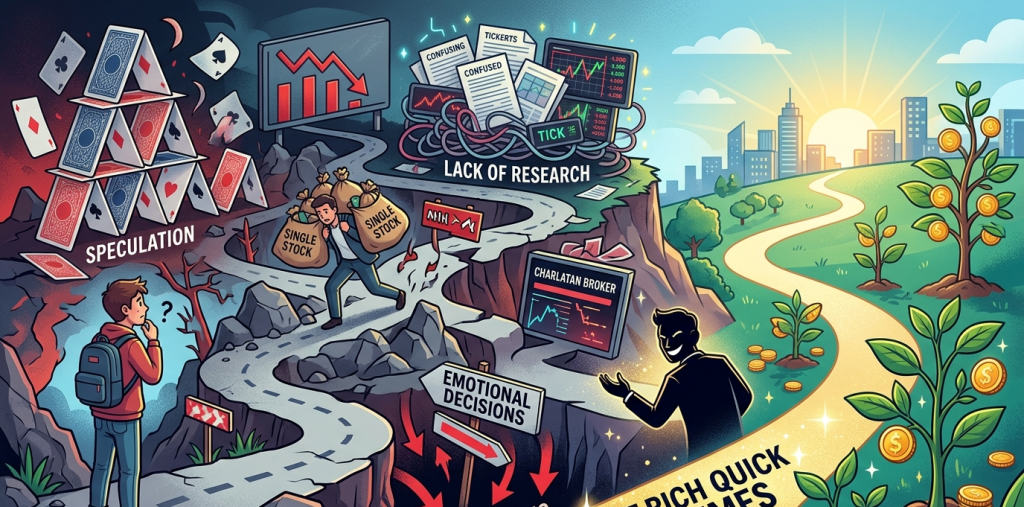
Mistake One: Trying to Time the Market
The most common and most destructive mistake new investors make is trying to time the market. They believe they can predict when the market will rise and when it will fall. They sell before expected declines. They buy before expected rallies. They almost always get it wrong.
The mathematics is unforgiving. The S&P 500 has delivered an average annual return of approximately ten percent over the past century. But those returns are not evenly distributed. The best days cluster around the worst days. If you miss the ten best days in a thirty-year period, your returns are cut in half. If you miss the twenty best days, your returns are cut by two-thirds.
No one can predict the best days. They come without warning. In March 2020, the market had its worst day since 1987. Three days later, it had one of its best days since 1933. The investor who sold after the crash missed the rally. The investor who held through the crash recovered.
New investors consistently sell at the bottom and buy at the top. They sell in March 2020 because they are terrified. They buy in December 2021 because they are greedy. They lock in losses at the worst possible moment. The solution is to stop trying to predict the market. You cannot. No one can. Buy and hold. Stay invested. Always.
Mistake Two: Chasing Past Performance
The second most common mistake is chasing past performance. New investors see that a stock or fund has performed well over the past year. They assume it will continue to perform well. They buy at the peak. Then the performance reverts to the mean. They lose money.
This pattern is so predictable that it has a name: the performance-chasing cycle. A sector performs well. Money flows in. The sector performs even better. More money flows in. The sector becomes overvalued. It crashes. The latecomers lose everything.
The technology bubble of 2000 was a performance-chasing cycle. The housing bubble of 2007 was a performance-chasing cycle. The cryptocurrency bubble of 2021 was a performance-chasing cycle. In each case, new investors bought at the peak because they saw others getting rich. In each case, they lost their money.
The solution is to ignore past performance. The best predictor of future performance is not past performance. It is low costs and broad diversification. Buy low-cost index funds. Hold them forever. You will never chase performance again.
Mistake Three: Trading Too Frequently
New investors believe that activity equals productivity. They think that buying and selling frequently will generate higher returns. The opposite is true. The most successful investors are the least active. Warren Buffett says his favorite holding period is forever.
Every trade has costs. The most obvious cost is the commission, though most brokers have eliminated commissions. The less obvious cost is the bid-ask spread. The difference between the buying price and the selling price is a cost you pay every time you trade. For liquid stocks and ETFs, the spread is small. For illiquid stocks, it can be large.
The largest cost of frequent trading is taxes. Short-term capital gains are taxed at your ordinary income tax rate, which can be as high as thirty-seven percent. Long-term capital gains are taxed at lower rates, typically fifteen or twenty percent. Frequent trading generates short-term gains. Buy-and-hold generates long-term gains.
The behavioral cost of frequent trading is the worst of all. Each trade is an opportunity to make a mistake. Each trade exposes you to your emotions. The less you trade, the fewer mistakes you make. The solution is to trade rarely. Set up automatic contributions. Rebalance once per year. Otherwise, do nothing.
Mistake Four: Using Leverage and Margin
Leverage is borrowing money to invest. Margin is a specific type of leverage offered by brokerage accounts. New investors are attracted to leverage because it magnifies gains. If a stock rises ten percent, a 2x leveraged position rises twenty percent. The problem is that leverage also magnifies losses. If a stock falls ten percent, a 2x leveraged position falls twenty percent. If a stock falls fifty percent, a 2x leveraged position is wiped out.
Leverage also has carrying costs. You pay interest on the borrowed money. In a high-interest-rate environment like 2026, those carrying costs are substantial. The market must rise just for you to break even.
The worst aspect of leverage is the margin call. If your account value falls below a certain level, your broker will demand additional funds or sell your positions. These forced sales happen at the worst possible time—when prices are already low. Investors who used margin in 2008 lost everything. Those who did not survived.
The solution is simple. Do not use leverage. Do not trade on margin. Do not buy leveraged ETFs. Invest only money you already have. Let compound interest work for you. It does not need leverage.
Mistake Five: Panic Selling
Panic selling is the natural human response to falling prices. The market drops ten percent. Your portfolio loses thousands of dollars. You feel pain. You want the pain to stop. You sell. The pain stops. Then the market recovers. You watch from the sidelines as your former holdings soar without you. The pain returns, worse than before.
Panic selling is the most destructive behavior in investing. It turns a temporary loss into a permanent one. The investor who held through the 2008 crash recovered within five years. The investor who sold at the bottom never recovered.
The solution is to prepare for bear markets before they happen. Decide now what you will do when the market falls twenty percent. Write it down. “When the market falls twenty percent, I will rebalance and buy more.” Then when the fall comes, you follow your plan. You do not panic. You act.
Mistake Six: Not Diversifying
New investors often fall in love with a single stock or sector. They put all their money into one company because they believe in it. This is not investing. This is gambling. No matter how much you believe in a company, you cannot predict its future. Enron employees believed in Enron. Lehman Brothers employees believed in Lehman Brothers. They lost everything.
Diversification is the only free lunch in finance. By spreading your investments across thousands of securities, you eliminate the risk that any single company will destroy your portfolio. An index fund gives you that diversification in a single purchase.
The solution is to build a diversified portfolio of low-cost index funds. Own US stocks, international stocks, and bonds. Own large companies and small companies. Own growth stocks and value stocks. You will never fall in love with a single stock again.
Mistake Seven: Ignoring Fees and Taxes
New investors focus on returns. They look for funds that have performed well. They ignore fees. They ignore taxes. This is a mistake. Fees and taxes are certain. Returns are uncertain. You can control fees and taxes. You cannot control returns.
The table below shows the impact of fees and taxes on a one hundred thousand dollar portfolio over thirty years, assuming an eight percent pre-cost return.
| Scenario | Annual Fee | Tax Drag | Effective Annual Return | Final Value |
|---|---|---|---|---|
| Low-cost index fund in retirement account | 0.03% | 0% | 7.97% | $1,006,000 |
| Low-cost index fund in taxable account | 0.03% | 0.50% | 7.47% | $875,000 |
| Active fund in retirement account | 1.00% | 0% | 7.00% | $761,000 |
| Active fund in taxable account | 1.00% | 1.00% | 6.00% | $574,000 |
The difference between the best scenario and the worst scenario is four hundred thirty-two thousand dollars. That is the cost of ignoring fees and taxes. The solution is to use low-cost index funds, hold them in tax-advantaged retirement accounts whenever possible, and avoid frequent trading that triggers short-term capital gains.
Mistake Eight: Investing Money You Need Soon
New investors often invest money they will need in the next few years. They put their down payment savings into the stock market. They put their emergency fund into cryptocurrency. They are chasing returns. They are taking unnecessary risk.
The stock market is volatile. It can fall fifty percent in a year. It can take five years to recover. If you need the money in two years, you cannot afford to wait for a recovery. You will be forced to sell at the bottom.
The solution is to match your investments to your time horizon. Money needed in less than five years should be in cash, certificates of deposit, or short-term bonds. Money needed in five to ten years can be in a conservative mix of stocks and bonds. Money needed in more than ten years can be in a growth-oriented portfolio. Never invest your emergency fund. Never invest your down payment fund.
Mistake Nine: Following Social Media “Gurus”
Social media has democratized investing advice. This is both good and bad. The good is that anyone can share knowledge. The bad is that anyone can share knowledge. There is no filter. There is no credentialing. A teenager with a TikTok account can claim to be an investing expert.
The vast majority of social media investing advice is terrible. It promotes get-rich-quick schemes. It encourages speculative trading. It hides the losses and highlights the wins. The gurus make money from views and clicks, not from investing. They do not care if you lose money. They care if you watch their videos.
The solution is to get your investing education from reliable sources. Read books by John Bogle, Jack Brennan, and Burton Malkiel. Read the Bogleheads wiki. Follow the principles of low-cost, diversified, long-term investing. Ignore the social media noise.
Mistake Ten: Having No Plan
The tenth mistake is the root of all the others. New investors have no plan. They do not know their goals. They do not know their time horizon. They do not know their risk tolerance. They react to events rather than acting according to a strategy.
An investor without a plan is like a ship without a rudder. Every wave pushes them in a different direction. The market rises, they buy. The market falls, they sell. A friend recommends a stock, they buy. A news anchor predicts a crash, they sell. They are controlled by the market rather than controlling their own destiny.
The solution is to write an investment plan. Write down your goals. Write down your time horizon. Write down your target asset allocation. Write down how you will respond to different market conditions. Write down how often you will rebalance. Then follow the plan. The plan protects you from your emotions. The plan keeps you on course when the market tries to push you off.
How to Avoid These Mistakes: A Simple Checklist
Avoiding these ten mistakes does not require genius. It requires discipline and a simple checklist.
First, stop trying to time the market. You cannot. No one can. Buy and hold.
Second, stop chasing past performance. Past returns do not predict future returns. Buy low-cost index funds instead.
Third, trade rarely. Set up automatic contributions. Rebalance once per year. Otherwise, do nothing.
Fourth, never use leverage. Do not borrow money to invest. Do not buy leveraged ETFs.
Fifth, never panic sell. Write a plan for bear markets. Follow it.
Sixth, diversify. Own US stocks, international stocks, and bonds. Own thousands of securities, not a handful.
Seventh, minimize fees and taxes. Use low-cost index funds. Use retirement accounts. Hold for the long term.
Eighth, match your investments to your time horizon. Do not invest money you need within five years.
Ninth, ignore social media gurus. Get your education from reliable sources.
Tenth, write a plan. Follow it. Review it annually. Update it as your life changes.
Conclusion
The mistakes new investors make are predictable. They are avoidable. You do not need to lose money to learn these lessons. You can learn from the mistakes of others.
The path to successful investing is not complicated. Buy low-cost index funds. Diversify across stocks and bonds. Hold for the long term. Ignore the noise. Rebalance annually. Pay attention to fees and taxes. Have a plan. Follow it.
The market will test you. It will fall. You will feel the urge to sell. It will rise. You will feel the urge to buy more. Through it all, your plan remains the same. You stay the course. You do not panic. You do not chase. You do not trade. You wait.
Over decades, this boring, disciplined approach builds wealth. It is not exciting. It will not make you rich overnight. But it works. It has always worked. It will always work.
Start today. Write your plan. Open your accounts. Set up your automatic contributions. Then walk away. Check back in a year. You will be glad you did.
Your Next Step: Write down your investment plan today. Include your goals, your time horizon, your target asset allocation, and your rules for rebalancing. Then open your brokerage account and compare your actual allocation to your target. Make any necessary adjustments. Set up automatic contributions. Then close the app. Do not check it again until next month.
Disclaimer: This content is for educational purposes only and does not constitute financial advice. All investing involves risk, including the potential loss of principal. Past mistakes do not guarantee future outcomes. Consult a licensed financial advisor before making investment decisions.