Most people use their bank incorrectly when they travel.
They rely on whatever card they already have, accept whatever fees appear, and assume that costs are unavoidable.
They are not.
Travel exposes inefficiencies in your financial system faster than anything else. Currency conversion, ATM withdrawals, international payments, hidden charges. Everything becomes visible.
This is where neobanks create a clear advantage.
But only if you use them correctly.
Because having a neobank is not the same as optimizing it.
And without structure, even the best financial tools lose their edge.
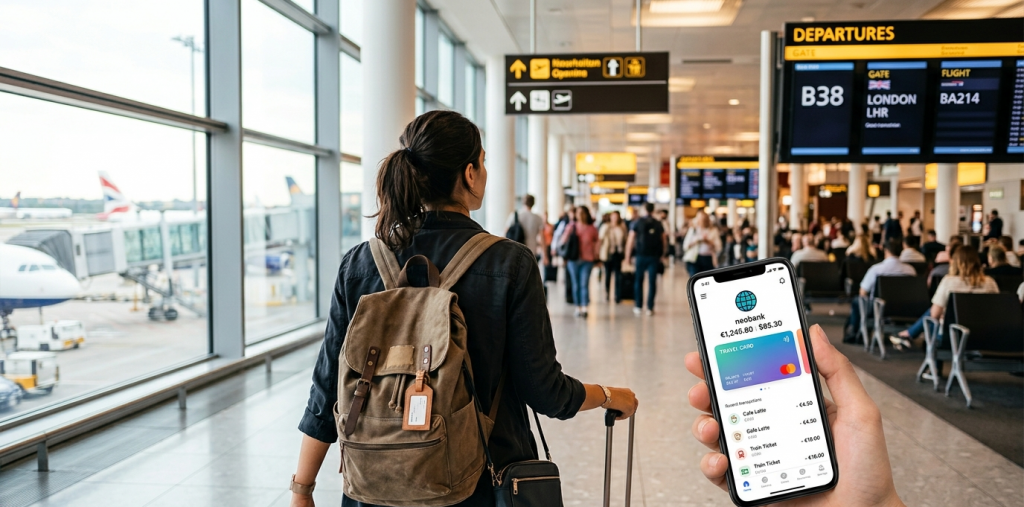
The Real Role of a Neobank While Traveling
A neobank is not just a payment method.
It is a control layer.
When you travel, your financial environment becomes fragmented. Different currencies, different systems, different pricing structures.
Traditional banks struggle in this environment because they were designed for domestic stability.
Neobanks were designed for movement.
This makes them particularly effective for travel.
But effectiveness depends on how you structure their use.
The First Principle: Reduce Friction Across Borders
Every time you move money internationally, friction appears.
That friction takes the form of delays, fees, or poor exchange rates.
Neobanks reduce this friction by simplifying three core elements.
They streamline currency conversion, they accelerate transaction speed, and they provide real-time visibility.
But none of this matters if you do not actively use these advantages.
Most users still behave as if they were using a traditional bank.
And that is where inefficiency returns.
Currency Conversion Is Where Most Money Is Lost
The biggest cost when traveling is not accommodation or transport.
It is currency conversion.
But it is also the least visible.
Traditional banks often apply hidden margins on exchange rates.
This means you are paying more than you realize on every transaction.
Neobanks typically offer near-interbank rates.
That is the advantage.
But there is a condition.
You need to let the neobank handle the conversion.
When paying abroad or withdrawing cash, you will often be asked whether you want to be charged in your home currency.
This option appears convenient.
It is not.
It is one of the most expensive choices you can make.
Selecting the local currency ensures that your neobank applies its own rate instead of the ATM or terminal provider.
This single decision can define your entire cost structure while traveling.
Cash Still Exists, and It Needs a Strategy
Even in highly digital regions, cash does not disappear completely.
You will encounter situations where it is necessary.
Small vendors, local markets, or certain services still rely on it.
Neobanks do not eliminate this need.
They change how you access it.
Because they depend on external ATM networks, your experience will vary depending on location.
Some withdrawals may be free.
Others may include operator fees.
Understanding this is essential.
The goal is not to avoid cash.
It is to control how you access it.
Table: Using a Neobank While Traveling vs Traditional Bank
| Aspect | Neobank While Traveling | Traditional Bank While Traveling |
|---|---|---|
| Currency Conversion | Near real exchange rates | Often includes hidden margins |
| International Fees | Low or transparent | High and less predictable |
| Payment Speed | Instant or real-time | Slower processing |
| Cash Withdrawals | Dependent on ATM networks | Direct access but higher fees abroad |
| App Control | Full real-time visibility | Limited or delayed updates |
| Budget Tracking | Built-in tools | Usually external or manual |
| Card Management | Instant freeze and controls | Slower response |
| Global Usability | Designed for cross-border use | Primarily domestic focus |
Payment Behavior Needs to Change
Using a neobank while traveling is not just about switching cards.
It requires a shift in behavior.
If you continue withdrawing cash frequently, ignoring exchange options, or failing to monitor transactions, you lose most of the advantages.
The optimized approach is different.
You rely more on digital payments.
You minimize unnecessary withdrawals.
You monitor your activity in real time.
This creates a smoother financial experience.
And more importantly, a cheaper one.
Real-Time Visibility Changes Decision Making
One of the most powerful features of neobanks is immediate feedback.
Every transaction appears instantly.
Every cost is visible.
This changes how you spend.
Instead of reviewing expenses after the fact, you adjust behavior in real time.
While traveling, this becomes even more valuable.
Because unfamiliar environments increase the risk of overspending.
Visibility reduces that risk.
Budget Control Becomes Simpler
Travel often disrupts financial discipline.
New environment, different pricing, unpredictable expenses.
Neobanks simplify control by integrating budgeting directly into the experience.
You can see exactly how much you are spending in each category.
You can adjust instantly.
This is not just convenience.
It is control.
And control reduces financial leakage.
ATM Strategy: Minimize, Don’t Eliminate
Many users try to avoid ATMs completely.
That is not necessary.
The goal is not elimination.
It is optimization.
Instead of frequent small withdrawals, a more efficient approach is to withdraw larger amounts less often.
This reduces the number of transactions.
And therefore reduces the probability of fees.
Combined with selecting the right ATM locations, this creates a much cleaner system.
Security Becomes More Important Abroad
Travel increases exposure.
New networks, unfamiliar locations, higher risk of theft or fraud.
Neobanks are particularly strong in this area.
They allow instant card freezing.
They provide transaction alerts.
They offer control over spending limits.
But these features only work if you actively use them.
Security is not passive.
It is operational.
Connectivity Is the Hidden Dependency
There is one limitation that most users ignore.
Neobanks depend on internet access.
Without connectivity, your ability to manage your account is reduced.
This is rarely a problem in developed areas.
But it can become relevant in certain regions.
Having a backup plan is not about distrust.
It is about redundancy.
The Hybrid Approach Works Best
Relying exclusively on one financial tool is rarely optimal.
This applies even more when traveling.
A structured approach often includes:
A neobank for daily spending and international efficiency.
A secondary card or account for backup.
This reduces dependency.
And increases flexibility.
The goal is not complexity.
It is resilience.
Fees Are Not the Enemy, Lack of Awareness Is
Many travelers focus on avoiding fees entirely.
This is not always realistic.
What matters is understanding them.
Paying a small, intentional fee in the right context is not a problem.
Paying repeated hidden costs without awareness is.
Neobanks help by making costs visible.
But visibility alone is not enough.
You still need to act on that information.
Behavioral Mistakes That Reduce Efficiency
Most inefficiencies come from behavior, not the tool itself.
Using the wrong currency option.
Withdrawing too frequently.
Ignoring limits.
Not checking exchange rates.
These are small mistakes.
But they accumulate quickly.
Optimization is not about major changes.
It is about eliminating these small inefficiencies.
Travel Patterns Define the Best Setup
Not all travelers have the same needs.
A short city trip is different from long-term travel.
A digital nomad operates differently from a tourist.
This affects how you should use your neobank.
Short trips may require minimal setup.
Long-term travel requires a more structured approach.
Understanding your own pattern is essential.
The Evolution of Travel Finance
Travel is becoming more digital.
Payments are faster.
Systems are more integrated.
Neobanks are positioned at the center of this shift.
They are not just adapting to travel.
They are shaping how financial interaction works globally.
This makes them increasingly relevant.
But also more complex.
Long-Term Advantage: Consistency Across Countries
One of the biggest benefits of using a neobank while traveling is consistency.
You do not need to adapt to each country’s banking system.
Your interface remains the same.
Your process remains the same.
This reduces cognitive load.
And improves efficiency.
Final Framework: How to Use a Neobank for Travel
The optimized approach is based on structure.
You minimize currency conversion costs by always selecting local currency.
You reduce ATM usage by planning withdrawals.
You rely on digital payments whenever possible.
You monitor transactions in real time.
You maintain a backup for resilience.
This is not complicated.
But it requires awareness.
Conclusion
Using a neobank for travel is not about convenience.
It is about control.
Travel exposes every weakness in your financial system.
And it rewards efficiency.
Neobanks provide the tools.
But tools alone are not enough.
The advantage comes from how you use them.
Once you approach it strategically, the difference becomes clear.
Lower costs, better visibility, and a smoother financial experience across borders.
And that is what optimized travel finance actually looks like.