Digital banking has grown rapidly over the past decade, introducing new terms that often confuse users. Two of the most commonly misunderstood concepts are neobanks and online banks.
At first glance, they may seem identical. Both operate digitally, both offer mobile apps, and both aim to simplify financial management. However, the differences between them are significant and can directly impact how you manage your money.
In this complete guide, we explain the real differences between neobanks and online banks in 2026, including how they work, their advantages, limitations, and which one is better for your needs.
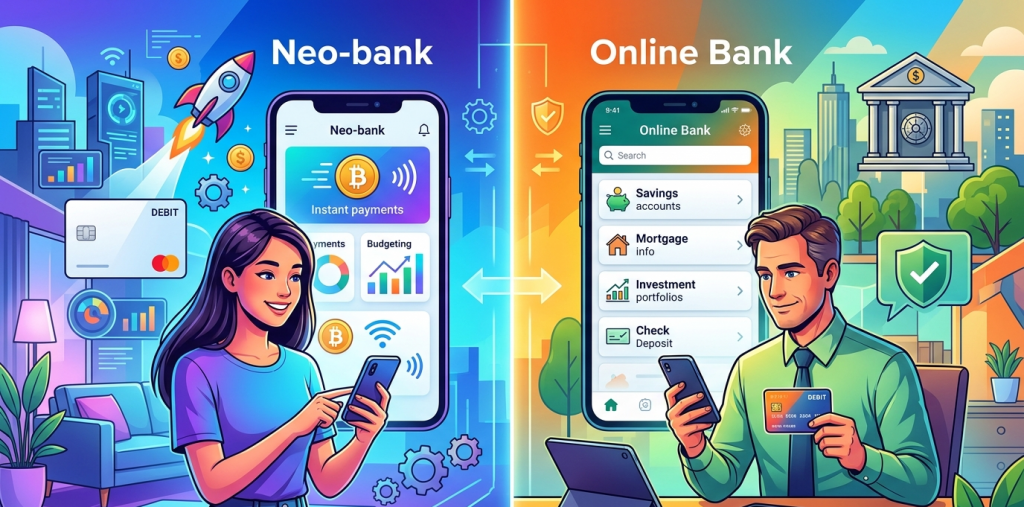
What Is a Neobank?
A neobank is a digital-first financial platform designed to operate entirely online, without physical branches.
Most neobanks are built using modern technology and focus on:
Mobile-first user experience
Low-cost services
Fast onboarding
Innovative financial tools
Some neobanks have full banking licenses, while others operate under partnerships with traditional banks.
This means that not all neobanks function in exactly the same way, but they share a common goal: to simplify banking through technology.
What Is an Online Bank?
An online bank is typically a traditional bank that offers its services digitally.
Unlike neobanks, online banks:
Usually have a banking license from the start
May be part of a larger, established financial institution
Offer a wider range of traditional banking products
Many traditional banks have developed online platforms to compete with fintech companies, creating what we now call online banks.
The Key Difference: Origin and Structure
The most important difference between neobanks and online banks lies in how they are built.
Neobanks are:
Technology-first companies
Designed from scratch as digital platforms
Often focused on specific user needs
Online banks are:
Banking-first institutions
Extensions of traditional banks
Built on existing financial infrastructure
This structural difference influences everything from features to fees and user experience.
User Experience: Simplicity vs Familiarity
One of the biggest differences users notice is the experience.
Neobanks prioritize simplicity. Their apps are designed to be intuitive, fast, and easy to use. Features like instant notifications, spending insights, and quick account setup are standard.
Online banks, on the other hand, often provide a more traditional experience. While their apps are improving, they may still feel more complex or less flexible compared to neobanks.
This makes neobanks particularly attractive to younger users and those who prefer a streamlined interface.
Features and Innovation
Neobanks are known for innovation.
They often include:
Real-time spending analytics
Budgeting tools
Multi-currency accounts
Integration with other fintech services
Online banks typically offer:
Savings accounts
Loans and mortgages
Credit cards
Investment products
While online banks provide a broader range of traditional services, neobanks tend to innovate faster and introduce new features more frequently.
Fees and Pricing Models
Pricing is another key difference.
Neobanks usually operate with:
Low or zero monthly fees
Transparent pricing
Freemium models (free basic account + paid plans)
Online banks may have:
Monthly maintenance fees
More traditional fee structures
Charges for certain services
However, this does not mean online banks are always expensive. Many have reduced fees to stay competitive.
The main difference is how pricing is structured and presented.
Regulation and Licensing
Regulation is one of the most important aspects when comparing these two types of institutions.
Online banks are almost always fully licensed banks. This means they:
Can hold deposits
Offer loans directly
Provide full banking services
Neobanks fall into two categories:
Fully licensed neobanks
E-money institutions that partner with licensed banks
Both are regulated, but the level of control and services may differ.
Security and Trust
Security is a major concern for users.
Both neobanks and online banks operate under strict regulations in Europe, which ensures a high level of protection.
However, there are differences in perception.
Online banks benefit from:
Long-standing reputations
Established trust
Physical presence (in some cases)
Neobanks rely on:
Advanced technology
Real-time security features
Modern authentication methods
In practice, both can be equally safe, but user confidence may vary.
Customer Support
Customer support is another area where differences appear.
Neobanks usually provide:
In-app chat support
Email assistance
Limited phone support
Online banks often offer:
Phone support
Email support
Sometimes physical branches
For users who value direct human interaction, online banks may feel more reliable.
Speed and Accessibility
Neobanks are built for speed.
Opening an account can take just a few minutes, and most processes are fully automated.
Online banks are also digital, but their processes may be slightly slower due to more traditional systems and regulatory requirements.
Accessibility is high in both cases, but neobanks tend to offer a more seamless experience.
International Capabilities
Neobanks often excel in international features.
They typically offer:
Multi-currency accounts
Low-cost international transfers
Competitive exchange rates
Online banks may provide international services, but they are often:
More expensive
Less flexible
Slower
This makes neobanks particularly attractive for global users.
Use Cases: When to Choose a Neobank
Neobanks are ideal for:
Everyday spending
Travel and international payments
Freelancers and remote workers
Users who value simplicity and speed
They are especially useful if you want a modern, mobile-first banking experience.
Use Cases: When to Choose an Online Bank
Online banks are better suited for:
Long-term savings
Loans and mortgages
Complex financial needs
Users who prefer traditional banking structures
They provide a more comprehensive range of financial products.
Can You Use Both?
In 2026, many users combine both types of banking.
For example:
A neobank for daily spending and travel
An online bank for savings and long-term financial planning
This hybrid approach allows users to benefit from the strengths of each model.
Common Misconceptions
There are several myths about neobanks and online banks that can lead to confusion.
One common belief is that neobanks are not real banks. In reality, many are fully licensed or operate under regulated frameworks.
Another misconception is that online banks are outdated. In fact, many are evolving rapidly and adopting modern technologies.
Understanding these differences helps avoid incorrect assumptions.
The Future of Digital Banking
The distinction between neobanks and online banks is becoming less clear over time.
Traditional banks are adopting fintech features, while neobanks are expanding into full banking services.
In the future, we can expect:
More hybrid models
Increased competition
Better services for users
Continued innovation
The focus will shift from labels to functionality and user experience.
Advantages of Neobanks
Neobanks offer several key benefits.
They are:
Easy to use
Cost-effective
Fast and accessible
Highly innovative
These advantages make them appealing to a wide range of users.
Advantages of Online Banks
Online banks also have strong advantages.
They provide:
Full banking services
Strong regulatory frameworks
Greater financial stability
Access to complex products
This makes them suitable for more traditional financial needs.
Limitations of Each
Neobanks may have limitations such as:
Fewer advanced financial products
Limited customer support options
Dependence on partner banks (in some cases)
Online banks may be limited by:
Less innovation
Higher fees in some cases
Slower processes
Understanding these limitations is key to making the right choice.
Which One Is Better in 2026?
There is no single answer to this question.
The best option depends on your personal needs.
If you value simplicity, low costs, and modern features, a neobank is likely the better choice.
If you need a full range of financial services and prefer a more traditional structure, an online bank may be more suitable.
In many cases, the best solution is to use both.
Final Thoughts
Neobanks and online banks are both important parts of the modern financial ecosystem. While they share similarities, their differences in structure, features, and use cases are significant.
Neobanks represent innovation, speed, and flexibility. Online banks offer stability, depth, and comprehensive financial services.
Understanding these differences allows you to choose the right option for your needs and take full advantage of what digital banking has to offer.
In 2026, banking is no longer one-size-fits-all. The best strategy is to choose the tools that work for you and use them intelligently.